Composite TL, SR#
Terminology#
The terms Transmission Loss (TL) and Sound Reduction (R) can be used interchangeably in INSUL:
- Both terms are used by acoustic consultants and manufacturers to describe the reduction in sound level that occurs across a partition such as a wall or ceiling.
- Both terms refer to the difference in sound level that can be measured across a partition when a sound source is on in a room on one side of the partition.
- Both terms are 'normalised' for the area of the partition and the characteristics of the receiving room.
- Transmission Loss (TL) is the ASTM term for the normalised difference in sound level.
- Sound Reduction (R) is the ISO term for the normalised difference in sound level.
The transmission coefficient for a partition (τ), is commonly referred to in textbooks and is defined as the ratio of sound power transmitted through a partition or element (W_{out}) to the sound power incident on that partition or element (W_{out}):
The transmission coefficient for a partition is related to its' Sound Reduction as follows:
What is composite transmission loss?#
If a partition comprises, say, 75% steel stud wall and 25% glazing, the sound reduction or transmission loss through the steel stud wall will be different from the transmission loss of the glazing.
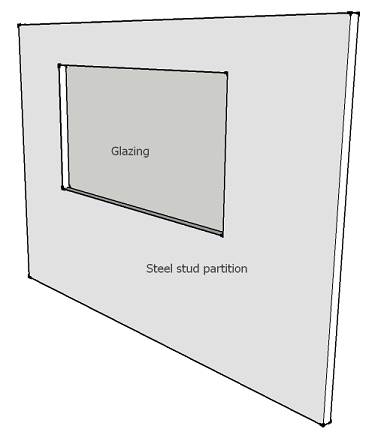
So what will be the transmission loss of the overall partition?
The theoretical transmission loss of the overall partition is called the Composite transmission loss or Composite TL.
Equations#
The composite transmission loss can be calculated as the average of the transmission coefficients (τ) of the individual elements that make up the partition. The average is weighted, according to the surface area (S) of each of the elements.