Glazing#
Single, Double & Triple Glazing#
A special empirical routine is built into Insul to predict the performance of double or triple glazing. This is more accurate than selecting glass as panel 1 and glass as panel 2 and then selecting no infill in the wall section.
From INSUL version 5, there is an option to have different glazing materials such as laminated glass, or clear plastic. This goes under different trade names such as Perspex, Lucite, Lexan etc. Different materials can be entered into the Glazing tab of the Materials Editor.
Note
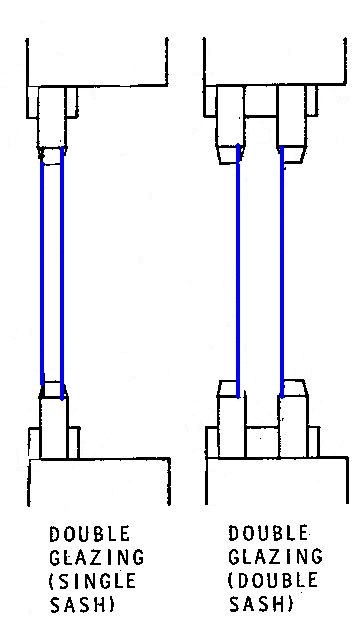
Note that the performance of glazing can be affected by the edge mounting conditions. INSUL glazing predictions are based on several sources but predominantly on measurements done at NRC in Canada in the early 80's. The mounting detals were as follows:
- timber sashes
- glass held in place by wooden strips nailed to the sash
- a thin bead of caulking sealant applied to ensure a good seal between glass and wood
From version 9.0 (release 8) you can select timber sashes (if you don't select timber then it assumes aluminium sashes).
From INSUL version 6.3, triple glazing can be modelled in INSUL. Note that this is largely empirically based. The main data used was from measurements carried out by Quirt (1983). But from release 9.0.8 additional data using aluminium frames/sashes has been included. You can select timber sashes (the default is aluminium)
The rather surprising finding was that the middle pane had very little effect. The middle pane adds mass to the assembly and increases the transmission loss below the mass-air-mass resonance, but above that frequency you could take out the middle pane and not notice the difference.
Important
Because the triple glazing routines are empirically based they should not be used outside the following limits:
- 3 to 6 mm panes
- maximum overall width of the assembly 120 mm
- aluminium or timber sashes
Laminated Glazing#
From INSUL version 7.0, laminated glass can be modelled as an elastic core material in INSUL.
Before INSUL version 7.0, laminated glass waas modelled as a single isotropic material, which did not allow the flexibility and accuracy to permit the user to vary glass thicknesses, interlayer thickness and type.

Choose the laminated glass type (i.e, the type of interlayer), then alter both the thickness of glass and the lamination thickness. The thickness of the lamination can be increased in steps = 0.38 mm (15 thousanths of an inch).
Tip
Laminated glazing can also be added to the Materials Editor.