Single Panels#
Mass Law#
Quote
An old and grizzled Acoustic Consultant once said that the solution to most sound transmission problems was mass, .... and money ..........and masses of money. This illustrates the fundamental importance of mass in sound transmission.
Walls consisting of a single homogeneous panel can be modelled quite well by the mass law up to the critical frequency. The mass law predicts the transmission loss (TL) from the surface mass (mass of 1m2 of the panel) and the frequency.
where:
- m is mass in kg/m2
- f is frequency in Hertz
Hint
The TL increases by 6 dB for each doubling of the surface mass or frequency.

A simple explanation of the mass law is that the motion of the panel is controlled by its inertia, the panel behaving as a limp mass, and the displacement or velocity of the panel reduces as the mass of the panel is increased or as the vibration frequency increases (because it is less easy to make the panel change direction more frequently).
To predict the performance of a material using the mass law one needs only to know the density of the material and the thickness of the material.
The mass law is a good approximation for the great majority of materials at low and mid frequencies. At higher frequencies the interaction of the bending waves in the material with the airborne sound waves reduces the transmission loss to below the mass law. The mass law predicts the Transmission loss of most materials up to the critical frequency. Above this frequency Cremer's (2005) theory is used to predict the Transmission Loss. The critical frequency is high for thin limp materials, such as lead, steel, plastics. For thick stiff materials the critical frequency can be low (brick, plywood). At still higher frequencies account must be taken of shear waves.
Note
Earlier versions of INSUL used a simple empirical model for concrete (for which shear waves are important), but versions after 4.8 correctly account for this behaviour.
Critical Frequency#
At low frequencies most materials behave as simple limp masses and the Transmission Loss can be predicted by the mass law.
At higher frequencies the bending stiffness of materials becomes important and at a certain frequency known as the critical frequency, the transmission loss dips well below the mass law. Above the critical frequency the TL increases at 12 dB/octave (doubling at frequency) so that as the frequency increases the TL can increase to above the mass law. From INSUL version 4.8, INSUL also takes account of shear waves which at some higher frequency reduce the transmissionloss back to 6 dB/octave. Note that this is usually only seen in very heavy masonry constrcutions.
Important
At the critical frequency the wavelength of bending waves in the panel equals the wavelength of airborne sound.
For homogeneous materials the product of surface mass and critical frequency is a constant, thus doubling the surface mass (by doubling the thickness of the panel) will halve the critical frequency. This constant can be calculated if the elastic modulus (also known as Young's Modulus) of the material is known. Alternatively, it can be inferred from a Transmission Loss test by examining the curve of TL versus frequency to determine the critical frequency (knowing the surface mass for that test).
Example
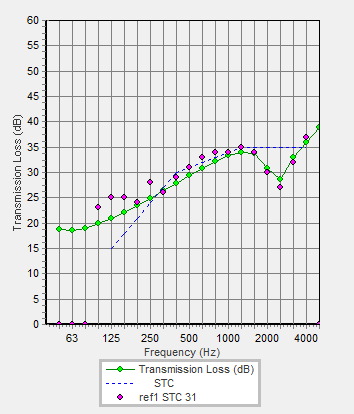
The example below shows the results for 6mm glass, the purple dots are actual test data, the green line the INSUL prediction. Note that 6mm glass has a surface mass of 14.6 kg/m2 and a critical frequency of 2330 Hz, giving a FCM constant of 34,000 kg Hz/m2.
Modulus of Elasticity#
The critical frequency of a panel is determined by the Modulus of elasiticity (sometimes known as Young's Modulus) and the thickness of the panel.
FCM
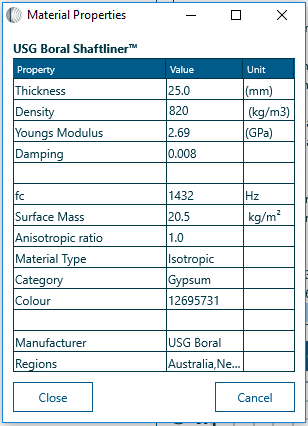
For most normal materials the product of the surface mass (kg/m2) and the critical frequency is a constant and this simple relationship can be used to quickly determine the coincidence frequency of any given thickness. This constant is called fcm in INSUL for want of any recognised term. For most building materials this constant falls in the range 10,000 to 100,000 Hz kg/m2, with gypsum plasterboard being about 30,000 Hz kg/m2. The elastic modulii have been determined for a range of building materials and are built into INSUL, but it is easy to adjust these by clicking on the picture of the material which displays the materials properties box and entering ones own values.
Tip
If the FCM is not known it can be calculated from the modulus of elasticity.
Damping (Loss Factor)#
Internal damping
The internal damping affects the transmission at and above the critical frequency. Generally it is found that a damping (loss factor) of 0.01 is a reasonable starting point for most building materials, but you can play around with this to get the best match with experimental data.
Edge damping
The edge damping factor models the energy loss that occurs at the edge of a normal partition where sound waves are transmitted into the surrounding structure. This is significant for very heavy partitions in normal constructions.
Tip
In some laboratory tests and some unusual situations the partition may not be solidly connected to the surrounding structure and so the energy loss is much less. In these situations the edge damping can be turned off.
Edge damping can be turned on and off from the Settings window.

Plate Resonances#
At low frequencies the sound insulation of a partition can be affected by resonances of the stiffened plates formed by the frame supports (typically timber or steel studs) and the linings or layers fixed to them (typically gypsum board or particle board panels). An illustration of what the first mode will look like is shown below (with acknowledgements to Morse).

From experimental results it appears that this effect is only significant on sound transmission when panels are rigidly fixed to both sides of the studs. The frequency of the dip at low frequencies that would normally be associated with the mass-air-mass resonance is pushed to higher frequency. A prediction for a steel stud wall with and without allowance for this effect is shown below. The experimental data is shown by the pink dots, the prediction in green does not account for plate resonances, the prediction in blue does. It can be seen that allowing for the plate resonance improves the prediction at low frequencies.
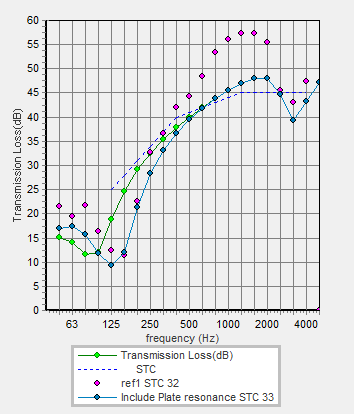
This effect is most important for small stud spacings, say 16" (or 400 mm). It is not so noticeable with stud spacings of 24" (or 600 mm).
Multiple Layers#
Multiple layers of one material
When two or more layers of a material are fixed together they generally do not behave the same as a single layer of increased thickness. For instance, two layers of 12.5 mm plasterboard do not give the same performance as one layer of 25 mm plasterboard.
At low frequencies the TL of both is the same as their combined mass, but the critical frequency of the 2 layers of 12.5 mm plaster board are the same as each individual layer, whereas the 25 mm thick plasterboard has a coincidence frequency half that of the 12.5 mm thick panel.
INSUL takes account of this and more than one layer of a material can be modelled accurately by changing the Number of value on the Layer tab (for example, Single > Panel 1 > Layer 1 > Number of).
Multiple layers of different materials
INSUL can model up to 6 layers of different thickness or indeed of different materials by using the Layer tabs Layer 1 through Layer 6 on the INSUL Panel tabs.

By default the Number of value for tabs Layer 2 through Layer 6 is 0. To add a material to a panel from anyone of these tabs, the Number of value must be increased.
Example
As an example, INSUL can model a single panel comprising 3 layers of 16 mm plasterboard and 2 layers of 6 mm plywood and 1 layer of fibre cement.
The INSUL model assumes that the multiple layers are only lightly fixed together. Most normal fixing methods would fulfill this assumption, for instance screws, spot gluing, nailing etc. However, if the layers are intimately bonded together for instance by a full coverage of glue (particularly a rigidly setting glue) then it would be more accurate to model the panel as a single panel of total thickness equal to the combined thickness of the multiple layers. For this reason INSUL models laminated glazing as a single material.
Laminated Panels#
Laminated panels are often used for sound insulation purposes. The most important is probably laminated glass in which a plastic material such as Polyvinyl Butyral is used as an interlay (or core) between two layers of glass. This is often done for safety reasons, but also has an acoustic benefit by:
- Reducing the overall stiffness of the laminated panel (thus increasing the critical frequency)
- Increasing the damping (thus reducing the dip at the critical frequency and increasing the transmission loss above the critical frequency).
Example
An example is shown below of a comparison between a single sheet of 6mm thick glass, versus 2 sheets of 3mm glass with a layer of PVB between, the overall rating is increased from about Rw 32 to Rw 39.

From INSUL version 7.0.8, INSUL can model these as elastic core materials. It is therefore possible to experiment with different thicknesses of glass and different interlayers (Core) to optimise the performance. There are several standard interlayers such as DuPont's Butacite® that can be used from a drop down list in the materials editor.

While the primary motivation of this development was laminated glass, this model could be used for other types of laminated materials including gypsum plasterboard with visco-elastic interlayers.
Corrugated and Trapezoidal Layers#
Thin materials are often corrugated or ribbed to increase their stiffness and hence ability to span larger distances between supports.
The bending stiffness of these types of materials is different in the direction of the corrugations compared to the direction at right angles to the corrugations. This can dramatically lower their transmission loss by lowering the critical frequency in the direction of the corrugations. Panels which have differing stiffness in each direction are known as orthotropic. Their sound transmission properties are well predicted by theories developed by Heckl (1960) and more recently by Windle and Lam (1994).
To model a corrugated or trapezoidal (ribbed) material use the INSUL Panel tabs to select Single > Panel 1 > Layer 1. Select Profiled Metal from the Category list and chose any material from the Product list. Now click on the material in the INSUL Illustration to open the Properties window. The dimensions of the corrugated or trapezoidal profile are displayed in the Properties window.

The profile dimensions can be changed directly from the Properties window by updating:
- Depth and pitch values for corrugated profiles
- Width, period, valley and height values for trapezoidal profiles
Trapezoidal layers also include a Lam and Windle ratio (Lc/Lw) parameter which is the ratio of the width of the crown of the profile to the length of the web of the profile. This parameter is from a paper by Windle and Lam (1994) and for values between 0.5 - 3 the algorithms of Windle and Lam are used.
Profile dimensions are stored in INSUL's database and can be accessed via the Materials Editor, where existing profiles can be permanently changed and new profiles can be added.
Sometimes trapezoidal steel sheets are used as permanent formwork to construct concrete floors. There are interesting features in predicting their performance of these Composite Steel Floors.
Elastic Core Materials#
INSUL can predict the performance of panel materials that have a compressible or elastic core (also inelastic cores). Such materials are often made with thin steel sheets as exterior facings (typically 0.5mm thick) with a core of PIR or expanded polystyrene or rockwool 70 - 250 mm thick. A typical product is the Kingspan KS1000 panel which is widely used for instance in the UK.

MetecnoPanel (PIR) by Metecno Pir
These types of panel have many useful construction properties such as good thermal insulation, ability to span long distances, and a pre-finished surface which speeds construction times. They are commonly used in industrial and commercial buildings. However they have a very significant dip in their sound insulation performance in the middle of the frequency range (the dilitational resonance frequency, commonly around 1 kHz) which combined with their light weight means that by themselves they have only modest sound reduction properties.
Another example of an elastic cored material is laminated glass which has a layer of a damping material between two layers of glass, for this type of elastic core the dilitational resonance is well above the audible range and so the dip in performance is not significant. For these laminated materials the major effect is the change in critical frequency and increase in damping.
INSUL can accurately predict the performance of elastic core materials (including this dip) and also more importantly can predict the sound insulation performance when combined with other materials, either with additional linings to increase the surface mass, or as part of a cavity wall or roof/ceiling construction.
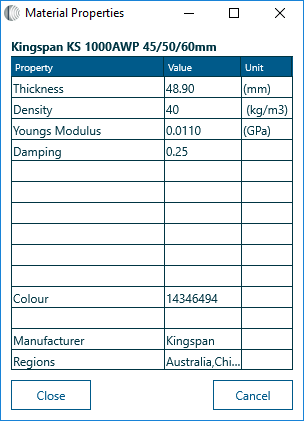
There are a variety of standard elastic cored materials in INSUL's standard materials file and more can be added either by requesting the developers to add specific materials or by modifying or extending the materials database file using the Materials Editor. The properties that define an elastic core material are the skins (density, thickness, damping and stiffness) and the core (density, thickness, Modulus of elasticity, damping and "plateau"). Note the plateau is a value usually between 0 and 10 dB. It is an empirical constant for a panel that is used to limit the improvement in insulation due to the dilitational resonance at high frequencies. Its value is not very important below about 2 kHz.
Temporary change to an elastic core material can be made from the Properties window. If the material is defined as an elastic core material the following properties will be displayed. Click on the skin on either side or the core to change the relevant properties.
Orthotropic Materials#
An orthotropic material is one that has pronounced differences in physical properties in two or more directions at right angles to each other. The effect of the orthotropicity is to introduce a second critical frequency and between the two critical frequencies the sound transmission loss is reduced compared to a simple isotropic panel. From version 6.4 INSUL can model orthotropic materials that have different stiffness in the plane of the panel. An example of such a material might be hollow core bricks, or steel trapezoidal roof sheets, or a concrete floor with cast in ribs.

INSUL can model both corrugated or trapezoidal (ribbed) materials as well as materials that are not profiled but have different stiffness in the X and Y directions.
The predictions are based on Heckl's (1960) paper "Untersuchungen An Orthotropen Platten". INSUL version 7.0 and earlier versions used simplified equations, however these do not include the effects of damping explicitly and do not cover the central portion of the frequency range. From INSUL version 8.0, a full numerical solution of Heckl's equations has been implemented. This is computationally intensive and some older and lesser powered computers may show a noticeable lag when computing orthotropic panels.
The INSUL model for these types of panels relies on the Orthotropic Ratio property which describes the ratio of stiffness in the y and x direction (By/Bx), where this ratio should always be greater than 1.
Temporary changes to the Orthotropic Ratio can be made from the Properties window. Permanent changes can be made from the Materials Editor.
Note
Note that from release 9.0.8 all timber materials are modelled as orthotropic.
Inelastic Core Materials#
INSUL can predict the sound insulation of panels with a stiff core and external skins.
Example
A typical example is Speedwall/Korok which has a lightweight concrete core inside a thin steel casing.
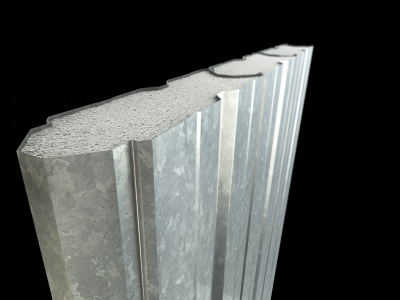
Because their core is very stiff these materials behave quite differently to Elastic core materials.
While INSUL predicts the transmission loss of Inelasitc Core materials using different algorithms than those used for elastic core materials, these two material types have common input properties, with the exception of the Core internal damping and plateau values, which are not used for Inelastic core materials.
Temporary changes to Inelastic Core materials can be made from the Properties window. Permanent changes can be made from the Materials Editor.
Composite Steel Floors#
A common method of constructing concrete floors is to use a trapezoidal steel pan onto which the concrete is poured.
The floor is relatively stiff because of the ribbing in one direction and the steel pan adds stiffness to the system by the composite action of the steel which has a high elastic modulus and is spaced away from the neutral axis. So the floors constructed this way are relatively light and stiff, not good characteristics for sound insulation generally.
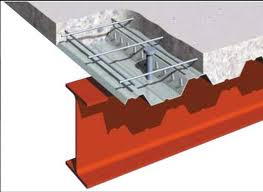
The different stiffnesses in the directions parallel and perpendicular to the steel profile give the floor different critical frequencies in each direction, that is the panel is orthotropic.
Calculation of the bending stiffnesses in each direction is not straight forward because the steel adds to the stiffness as do the corrugations. INSUL uses a method published in ANSI/SDI C-2011 Standard for Composite Steel Floor Deck - Slabs.