Outdoor to Indoor Calculator#
INSUL is primarily a tool for predicting the sound transmission loss of a wall or floor. However, a simple calculation tool has been added for working out the overall transmission of noise from outside to inside. For instance, with aircraft or road traffic noise incident on a house or the facade of an apartment, what will be the noise level inside a particular room? INSUL can be used to complete this calculation.
Getting started#
Open up the calculator by clicking on the  button on the INSUL toolbar. Note that this form can now (since 8.0.4) be open at the same time as the main INSUL form.
When the calculator opens, there are several areas where data input is required. These are marked by a red cloud and discussed further below.
Note
In general, data is required at every frequency.
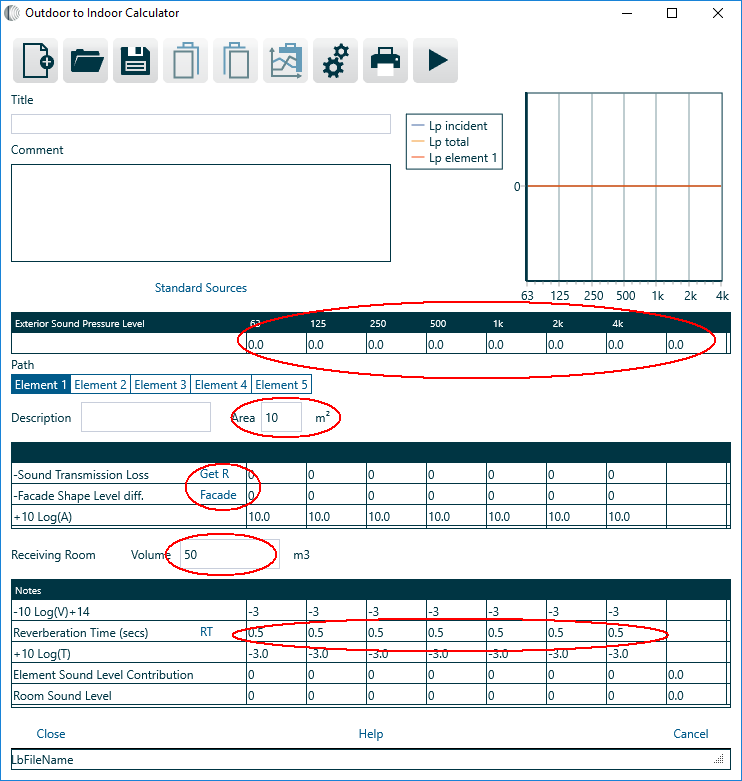
Setting up a calculation#
In addition to the sound transmission loss of the wall (predicted by INSUL) we also need to know:
- the outdoor noise level incident on the wall
- the area of the wall and, possibly, it's shape
- the volume and reverberation time of the room
There may be several elements to the facade, such as the main external wall construction, a window and an additional transmission path through a side wall. Each path needs to be considered separately. The sound transmission loss and area of each path must be known or estimated.
Outdoor noise level#
The sound transmission loss is a function of frequency and in general, the outdoor noise will consist of a mixture of different frequencies. Thus, the calculation must be made over the normal audible frequency range.
The noise level inside the room will depend on the frequency spectrum of the noise source. For instance, noise from nightclubs or bars will often contain a lot of low-frequency sound energy and lightweight building elements like windows will provide only a small amount of attenuation of that noise. Therefore, it is important that the frequency spectrum of the noise is either known or can be estimated with reasonable accuracy. INSUL contains a small calculator which can estimate the frequency spectrum if the overall A-weighted noise level is known. For instance, traffic noise can be estimated reasonably well in free-flowing conditions from a standard spectrum given in ISO 717, or male speech spectrum can be estimated from ANSI S3.5. Click on the  button and the following form will appear.
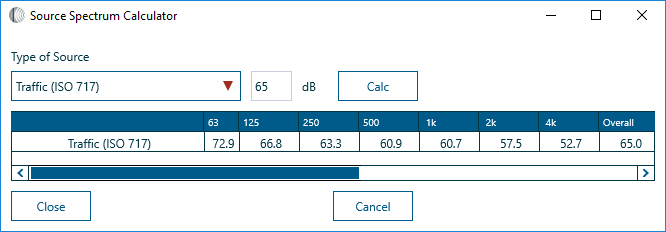
Choose the type of source from the drop-down box and set the overall A-weighted level.
Tip
You can also cut and paste a spectrum into the Source Grid back on the Outdoor to Indoor Form using Ctrl+c when the cursor is positioned on the 63 Hz cell.
Very Important Note
The source sound level to be entered into the calculation sheet is the sound level incident on the building facade, but measured or assessed with the building not there. It is the free field level. If you have a noise level measured in the presence of the building, then this measured level will include some reflection from the facade. In general, if you measure 1 to 2 metres from the facade, the noise level will be about 3 dBA higher than the free field level (i.e. with the building not there).
Facade shape level difference#
As noted in EN12354/3 the facade of the building can affect the sound transmission by either shielding or reflective effects. The aforementioned standard contains a table of corrections to be applied to the calculations depending on the facade arrangement. In INSUL, you can click on the  button. This brings up a form that shows the vertical cross-sections of some different arrangements. Click on the picture most closely describing your situation. The effect of reflection from an overhanging balcony above, and whether this balcony has an absorptive surface, and the shielding effect of one's own balcony front can be allowed for.
For other situations, custom facade shape adjustment values can be entered directly into the table.
Tip
Based on consultants' experience, our current practice is to use:
- -6 dB factor for the shielding of a side wall which is not directly visible by the source
- -3 dB for a roof
- -10 dB for a rear wall
These values are for guidance only and may be updated as more current research and experience becomes available.
Reverberation time, room volume#
The volume of the indoor space and its reverberation time affect the level of sound from outdoors.
The reverberation time can often be estimated with reasonable accuracy from a knowledge of the room and its furnishings. It is a convenient phenomenon that for general living spaces such as bedrooms and living rooms the reverberation time of most rooms turns out to be close to 0.5 seconds and reasonably flat across the frequency range. Thus, for normal domestic rooms in the range 20 m3 to 200 m3, you can use 0.5 seconds at all frequencies as a reasonable estimate. For different rooms that are either much larger or more sparsely furnished, the reverberation time should be either calculated or measured.
Angle of incidence#
An often-overlooked factor with outdoor to indoor calculations is that all sound transmission loss data that is commonly provided is measured (or calculated) for a random incidence field on both the source and receiver side of the partition. Yet, as acoustic textbooks point out, the sound transmission loss of a partition will vary with the angle of incidence, reducing as the angle of incidence approaches grazing incidence. Thus you would expect that the transmission loss of the facade and hence the internal noise level in the room should vary with the angle of incidence of the external noise. However, research undertaken by Rindel (1975) shows that for finite-sized partitions (i.e. not infinite sized partitions) and for low and mid frequencies there is little actual influence of angle of incidence on the "External" transmission loss.
To explain this in a different way, in classical acoustics the sound transmission loss (defined in terms of incident intensity) tends towards zero at grazing incidence. However, the incident sound power will also tend towards zero because the projected area that the sound wave is incident on tends to zero. Thus, it is not clear what wins, the incident level tending to zero or the transmission loss tending to zero. What will the internal level be? Rindel avoided the confusion by defining the "External Transmission Loss" as the ratio of the energy densities of the sound fields on the source and receiver sides. The external energy density does not go to zero at 90° incidence and the External transmission Loss can be estimated from the traditionally measured random incidence transmission loss. These effects are included in the outdoor to indoor calculations carried out by INSUL. The same effects are included in EN 12354/3 in section 4 when it describes the general principles of the calculation model. The apparent sound reduction index of the facade is given as equal to the random incidence sound transmission loss.
Thus trying to reach a simple conclusion, the answers calculated by INSUL are a good prediction for noise that is incident from a range of different angles of incidence (e.g. traffic noise) and furthermore is a reasonable approximation for most building facades for any angle of incidence. The answers for specific angles of incidence could be in error at frequencies above 1 kHz. For either normal incidence sound or for grazing incidence sound, the maximum expected error at say 4 kHz would be ±3 dB, and for most noise sources these frequencies would not determine the overall loudness of the internal noise.
Octaves versus 1/3 Octaves#
Acoustic calculations are generally required to be carried out at a range of different frequencies. The Outdoor to Indoor Calculation in INSUL can be carried out either in octave or 1/3 octave bands. The choice is primarily dependent on the information available and the degree of accuracy required. Traditionally, octave bands have been used for engineering calculations, probably because historically this sped up calculations by a factor of 3 without much loss of accuracy for most purposes. For many noise sources which are broadband in nature (e.g. traffic noise), the change in precision between the use of octave or 1/3 octave bands would be very small. If you have all the data available in 1/3 octave bands, then there is little point in not using it. If however some of your data is only in octave bands, then use octave bands.
INSUL can be set to use either octave band data or 1/3 octave band data. Go to the settings page and choose the bandwidth.
Standards#
INSUL calculates Outdoor to indoor transmission in accordance with
- EN 12354-3:2000 "Building Acoustics - Estimation of acoustic performance of buildings from the performance of elements - Part 3: Airborne sound insulation against outdoor sound"
D2m,nT#
INSUL displays the D2m,nT value on the Outdoor to Indoor Transmission calculation form.
If you are not familiar with ISO standards, then this needs some explanation. This quantity is a standardised measure of facade performance. It is the difference between the outdoor sound level measured 2 metres from the facade (thus including the effects of reflection from the facade), and the spatial average sound level inside the receiving room when the receiving room has a reverberation time of 0.5 seconds (at all frequency bands). This quantity will vary somewhat depending on the volume of the room and the area of facade exposed, so it is not a unique quantity of the partition.