Energy-based Glazing Model#
Info
INSUL provides two separate methods for predicting the sound insulation performance of glazing systems: an energy-based model and a wave-based model.
The energy-based model is discussed below
The energy-based model of sound transmission through glazing implemented in INSUL is based on the use of a mixture of infinite-panel and energy-based theoretical analysis models that have been augmented with measured results.
Single, Monolithic#
Options for modelling single, monolithic materials include monolithic glass and a range of clear plastic materials such as Perspex, Lucite, and Lexan.
Single, Laminated#
Laminated glass comprises two layers of glass press together with a polymer interlayer material such as PVB (polyvinyl butyral).
In INSUL, laminated glass is modelled as an elastic core material. In earlier versions of INSUL, laminated glass was modelled as a single isotropic material, which did not allow the flexibility and accuracy to permit the user to vary glass thicknesses, interlayer thickness and type.
More notes about laminated panels...
Laminated panels are often used for sound insulation purposes. The most important is probably laminated glass in which a plastic material such as Polyvinyl Butyral is used as an interlay (or core) between two layers of glass. This is often done for safety reasons, but also has an acoustic benefit by:
- Reducing the overall stiffness of the laminated panel ~ thus increasing the critical frequency.
- Increasing the damping ~ thus reducing the dip at the critical frequency and increasing the transmission loss above the critical frequency.
Example
This example compares a single sheet of 6mm thick glass with 2 sheets of 3mm glass with a layer of PVB between, the overall rating is increased from about Rw 32 to Rw 39.
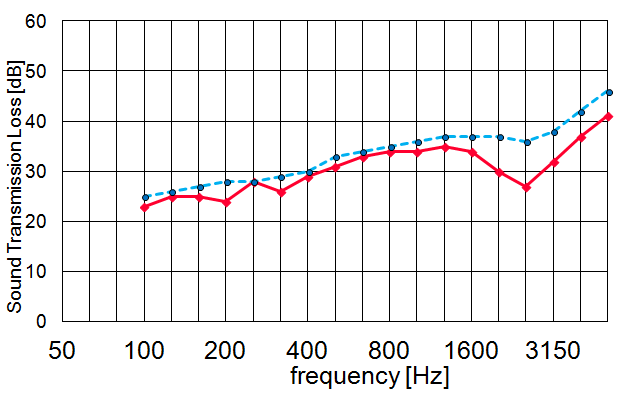
INSUL can model these as elastic core materials. It is therefore possible to experiment with different thicknesses of glass and different interlayers (Core) to optimise the performance. There are several standard interlayers such as DuPont's Butacite® that can be used from a drop down list in the materials editor.

While the primary motivation of this development was laminated glass, this model could be used for other types of laminated materials including gypsum plasterboard with visco-elastic interlayers.
When a laminated material is added to an energy-based glazing model, the total thickness of the glass and the laminate can be set.
-
The thickness of the lamination can be increased in steps = 0.38 mm (15 thousanths of an inch).

-
The glass thickness is assumed to be distributed equally on each side of the interlayer. For example, if a laminate material has a glass thicknes of 6 mm, the energy-based model assumes a general composition as follows: 3 mm monolithic glass; interlayer; 3 mm monolithic glass.
To model laminated glazing with panes of glass of unequal thickness on each side of the interlayer, use the wave-based model.
Double#
A special, empirical routine is built into the INSUL energy-based model to predict the performance of double and triple glazing.
An important factor that affects the overall sound insulation peformance of double glazing is the edge mounting conditions.
The algorithms implemented in INSUL's energy-based model have been developed using laboratory sound insulation test data from several sources for validation. The predominant source of valildation data is measurements carried out at NRC in Canada in the early 1980's. The mounting detals for the NRC Canada measurements were as follows:
- Timber sashes
- Glass held in place by wooden strips nailed to the sash
- A thin bead of caulking sealant applied to ensure a good seal between glass and wood

By default, the energy-based model assumes aluminium sashes.
If the 'Timber sash' check box is selected then the model will assume a timber sash.
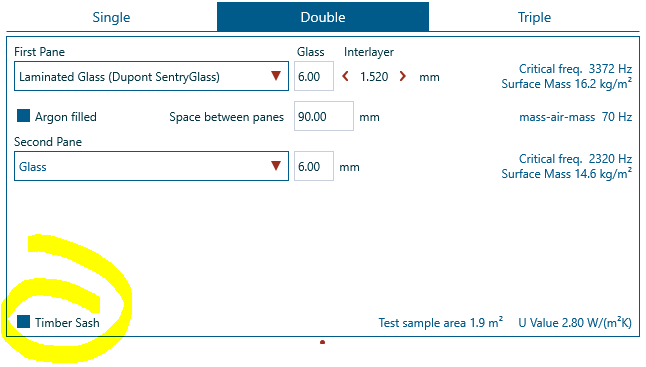
The cavity of a double or triple glazing system can be modelled as having either air or argon as the cavity gas.
Triple#
Energy-based triple glazing routines in INSUL are largely empirically based. The algorithms have been developed using laboratory sound insulation test data mainly from measurements carried out by Quirt (1983).
Caution
Because the triple glazing routines are empirically based they should be used within the following limits:
- 3 mm to 6 mm panes
- Overall system widths less than about 120 mm
- Aluminium or timber sashes
As with double energy-based models, there is an option for timber sash edge mounting conditions and a cavity can be modelled as having either air or argon infill gas.