Timber Frames#
In a double panel wall, there are various ways in which the two sides of the wall can be connected. These connections provide a path for the transfer of vibrational energy which is then radiated as sound.
Some of the timber frames included in INSUL are discussed below.
Timber Studs#
A common form of construction is to use timber studs to make a framework and line either side with plasterboard or similar panel materials. Timber studs are usually 100 x 50 mm in cross-section but can be smaller or larger depending on structural requirements. Timber studs act as very stiff, light connections between panels.
From this discussion, it is apparent that this option is only valid where the panels are rigidly connected and the panels make a connection along with the whole length of the stud.
If a resilient element is placed between the stud and the panel then the TL will, in general, be increased above what is predicted from timber studs.
There are different construction methods for reducing or eliminating the structural transmission through the studs, some common forms are:
These methods are discussed in turn below.
Staggered Studs#
A question often asked is:
"When a construction is calculated with double (wood) studs or staggered studs the results change dramatically. There isn't much constructional difference between double studs or staggered, both have no contact from the inside panel to outside. So should not the difference in acoustical terms be comparable?"
The answer lies in the detail of their respective construction. A staggered stud wall usually has a common top and bottom plate (see picture below), so there is a direct bridge between the sides of the wall. INSUL models this as a connection with a length that is equal to the perimeter of the frame. However, a double-stud wall has two completely separate rows of studs, and so no structural connection between the two sides and therefore a much higher sound insulation performance.

Staggered Stud wall construction

Double-stud wall construction
Resilient Rails#
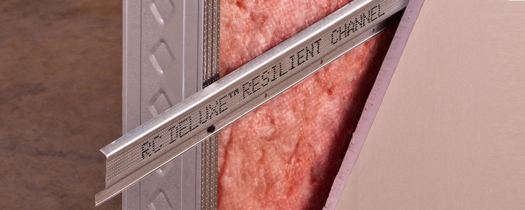
Resilient rails are used in partition walls to increase the TL. They are normally fixed to timber studs, with the wall or ceiling linings fixed to the resilient rail rather than directly to the stud.

The function of the rail is to prevent direct vibration transmission via the stud by acting as a soft spring between lining and stud. Resilient rails are usually steel channels folded in such a way as to be quite springy. They are normally fixed in horizontal lines at 600 mm centres.
Caution
They are very easy to install wrongly however and with inexperienced workmen, the chances are that the wall will not achieve the predicted or lab performance. The user should be very careful that the properties of the resilient rail are similar to the well known USG resilient rail, as there are several copies of this used which do not provide the same degree of isolation.
Sometimes resilient rails are used on both sides of a wall. However, the result is only slightly better than using on only one side and so there is little to be gained. Be wary of using the resilient channel option for any brands that are not of identical design to the Detrich RC deluxe resilient Channel (see below).
Rubber Isolation Clips#
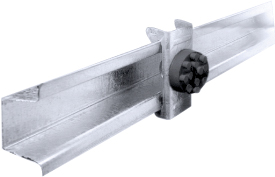
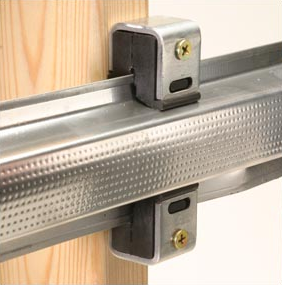
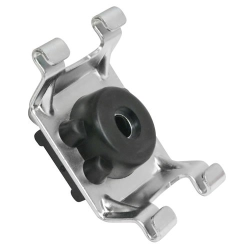
Improved performance can be achieved with a metal bracket incorporating a rubber or neoprene isolation element. A good example is the RSIC clip from PAC International. This fixes to the stud or joist and holds a metal channel to which the wall lining is screwed. Another example is the Kinetics IsoMax clip, and another one is the Pliteq GenieClip™ . The rubber or neoprene ensures a high degree of isolation from the wall frame and sound insulation can approach a double frame wall performance. It is also much more reliable than resilient rails.
Ceiling Supports#
In the case of a ceiling, it is possible to introduce a resilient element. Normal practice is different in different countries. In North America, it is common to use a 13 mm resilient metal channel. In Australia, it is common to use resilient clips (e.g, Rondo or Gyprock or RSIC) while in New Zealand the Gib Ceiling batten can be used to provide isolation. The RSIC clips are also able to be used in a ceiling and as in a wall, they provide a high degree of isolation.
Double Studs#
Double studs provide the ultimate in performance for framed partition walls. They are constructed by erecting two separate frames, usually 25 mm apart, and lining the outside of each frame typically with 1 or 2 layers of plasterboard. Because there is no physical contact between each side of the wall, the only transmission path is via the air cavity and provided this has an absorbent blanket very high TL's can be achieved. In practice flanking transmission would often prevent the very high TLs predicted at high frequencies, but in extreme cases where measures have been taken to prevent flanking TL's of 60-70 dB at 1 kHz and above can be achieved (e.g. adjacent rooms on concrete floating floors).
Double timber stud (in generic, continuous test frame)
This Double timber stud (in generic, continuous test frame connection is a varition on the Double Stud frame type.
The generic, continuous test frame is intended to provide a rough approximation of the collar that is used in a laboratory to mount a wall or ceiling for testing. The collar in this "generic" case is assumed to be 100 mm of dense concrete, which represents many instances of laboratory collars.
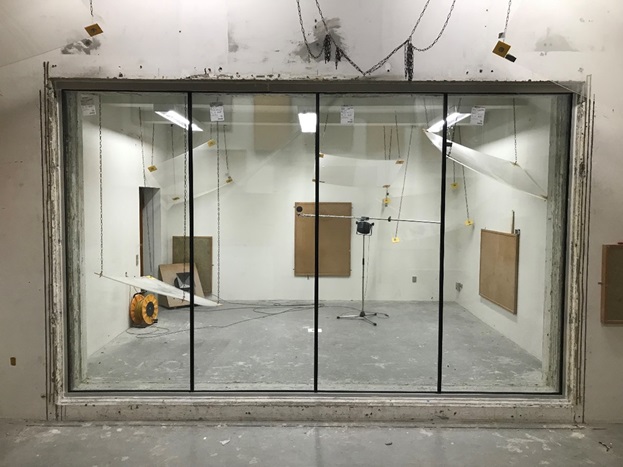
The collar is a potential flanking path during sound insulation testing. The effect that the flanking path may have on measured sound insulation values will likely vary significantly from lab to lab and also from test to test, depending on the type of partition being tested and how it is mounted or built into the collar.
With the generic, continous test frame, INSUL sets that the width of the 100 mm deep collar to match the depth of the partition cavity. The intention of this frame type in INSUL is to provide an indication of the type of flanking that might occur in a laboratory test in some cases.
Actual levels of collar flanking could vary significantly from the INSUL prediction as a result:
- Differences in collar type and size (for example, some laboratories use a collar with a timber inner as this allows for convenient fixing of the framing of the test partion)
- How the collar is mounted into the test opening
- Whether the collar is blanked off as part of the partition test procedure
- The sound insulation performance (direct path) of the test partition
Because of this variability, INSUL predictions which include this frame type should be interpreted with an appropriate uncertainty tolerance.