Accuracy & Limitations of Impact Sound#
Agreement with Measured Data#
Users should be aware of the limitations of the INSUL predictions, like any prediction tool it is not a substitute for test data. Comparisons with test data show that INSUL is generally:
- ± 3-5 Ln,w/IIC points for most massive constructions which include a concrete floor.
- ± 3-6 Ln,w/IIC points for most lightweight floor constructions where the combined thickness of the floor layers is less than approximately 25-35 mm.
The transition between thin, lightweight floor constructions of less than 25-35 mm and massive floor constructions such as concrete which are 75 mm or thicker involves a transition from the force function for lightweight floors according to Brunskog and Hammer (2003) to the classical impact force theory of Cremer (2005). Accordingly, impact sound insulation predictions in the intermediate region can be less accurate. Based on available test data, which is somewhat limited, INSUL is generally ± 5-10 Ln,w/IIC points for relatively thick, lightweight floor constructions where the combined thickness of the floor layers is approximately 35-75 mm.
Agreement with Measured Data at Low Frequencies#
Variability of both measured and predicted sound levels at low frequencies, below about 100 Hz, is much greater than at higher frequencies. The variability may be caused by many factors including the larger wavelengths of sound in the low-frequency region, the relatively small size of test samples and natural modes of vibration of the test panel, its supporting structures such as joists and the receiving room.
INSUL impact sound insulation predictions may vary from measured data in individual one-third octave bands in the low-frequency region by 10 Ln,w/IIC points or more. Care must be taken when low-frequency impact sound insulation methods are being designed.
Example 1
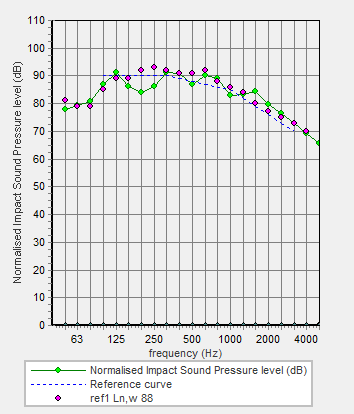
INSUL comparison with measured impact sound pressure levels for a thin, lightweight floor construction: 2 layers of 15 mm plywood (NRC test IIF-96-062).
The INSUL predicted level is Ln,w 88 dB.
Example 2
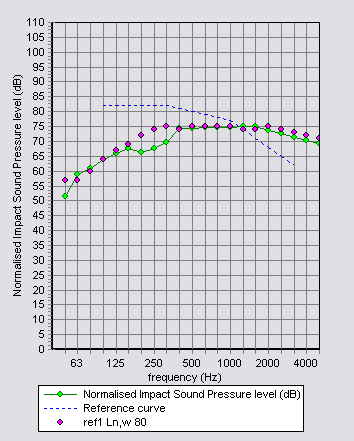
INSUL comparison with measured impact sound pressure levels for a massive, concrete floor construction: 100 mm concrete slab (NRC test IIF-98-003).
The INSUL predicted level is Ln,w 80 dB.
Example 3
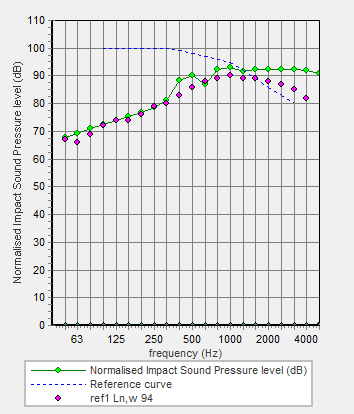
INSUL comparison with measured impact sound pressure levels for a thick, lighter-weight floor construction: 35 mm concrete + 15 mm OSB (NRC test IIF-96-072).
The INSUL predicted level is Ln,w 98 dB.
Griffin (2014) provides a discussion of the expected accuracy of impact sound pressure level calculations.
Floor Covers#
INSUL can predict the reduction of impact sound from the use of some types of floor covers. A discussion of the accuracy of these predictions can be found here.