Flanking#
A note about flanking#
In all situations where sound insulation is important the transmission of sound by secondary or flanking paths should be considered. This is especially true when high-performance partitions (STC/Rw 55 or greater) are to be used.
INSUL can predict the performance of Triple and Quad panel partitions. It is easy to design a partition that will have a high calculated or predicted performance in a laboratory test, but which will not achieve the desired sound insulation when installed on site, because the sound will be transmitted around the partition by various flanking paths.
The picture below shows a few of the possible flanking paths (in red). With 2 rectangular boxes joined together on one face there are 12 possible flanking paths that will contribute.

INSUL does not directly calculate the flanking transmission within a building. Rather, INSUL provides a visual indicator of the level of flanking transmission that might be experienced in a typical building, as a reminder that flanking transmission must be considered, or special measures taken to reduce flanking, in order to achieve high sound insulation between spaces. A fuzzy light purple line is shown on the graph, to indicate approximately the likely flanking transmission.

Note
The degree of flanking transmission is dependent on the type of building elements surrounding the partition. The flanking will be different depending on the weight of the construction and any vibration isolation in the structure.
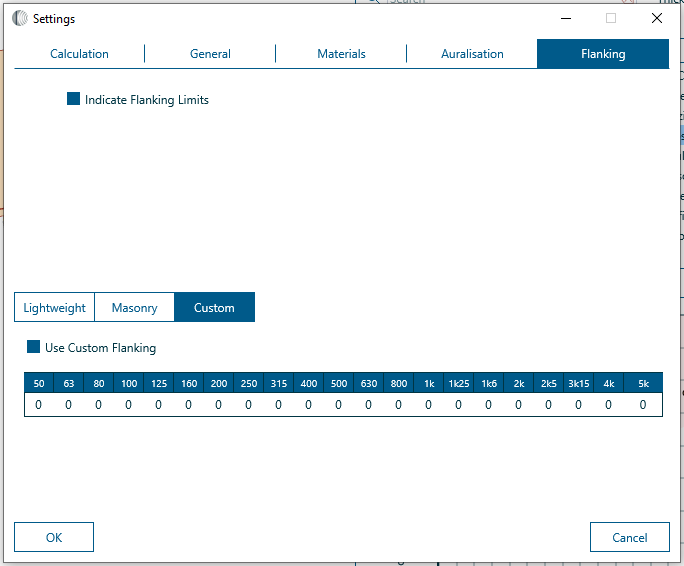
The flanking construction can be changed in the Settings window,  , by selecting the Flanking tab. From the Flanking tab there are options for three
alternative flanking construction types: Lightweight, Masonry and Custom.
, by selecting the Flanking tab. From the Flanking tab there are options for three
alternative flanking construction types: Lightweight, Masonry and Custom.
Lightweight Construction#
For lightweight construction, it is not practical at this time to calculate the flanking transmission and so experimental results have been used to predict the flanking for some common constructions.

Note
Flanking in lightweight structures
Flanking sound in lightweight structures is still an area of active research and tools for predicting flanking transmission in typical lightweight structures like timber-framed buildings are still being developed.
For INSUL at this stage of development, we have chosen to use experimental data for some typical constructions and use that data as a guide for the user to determine when flanking transmission might contribute significantly to the overall sound transmission between spaces and when special measures might need to be taken to reduce flanking transmission.
The construction options in INSUL for which experimental data for flanking transmission are available are as follows:
-
Continuous lightweight floor (e.g 17mm plywood)

-
Continuous floor with topping (eg 40mm gypsum concrete on resilient underlay)

-
Continuous floor with a raft (eg 2x20mm particle bd on 13mm fibreglass)

-
Continuous lightweight walls (horizontal e.g, side walls)
-
Continuous Lightweight walls (vertical)
Masonry Construction#
For masonry construction, the European Standard EN 12354-1:2000 provides a simple method for estimating flanking transmission. INSUL incorporates a few simple results based on masonry construction of various thickness and junction details.

Customised Flanking Limit#
It is also possible to enter customised values for the flanking limit. These are stored by INSUL when you exit the program, for use during future sessions.