Floor Size#
Floor Size & Joist Orientation#
The floor/roof size can be set from the Properties window. The floor/roof size is set independently from the partition size as the dimensions of a floor/roof in a laboratory are often different from those of a partition.
The arrangement of joists relative to the floor/roof panel is shown below.
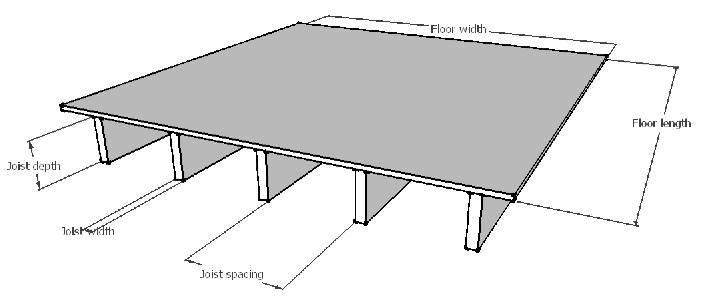
INSUL assumes that the joists run along the length of the floor. Adjusting the length of a floor/roof will also adjust the length of the joists.
Effect of Floor Size on Predicted Sound Levels#
Intuitively, it may seem that increasing the floor size should increase the sound level in the receiving room. However, this need not be the case, owing to the following:
- Using a tapping machine, or laboratory simulated rainfall, the input energy into the floor/roof layers does not change with changes in floor/roof size. The is different from airborne sound insulation, where increases in the partition area also increase the sound power level into the partition.
- Increasing the area of a floor/roof increases the radiating area of the construction. However, this increase is proportional to the decrease in vibration caused by the impact force having to excite a more massive object. In broad terms, these two effects cancel each other out.
- Sound radiation efficiency theory by Maidnik demonstrates that an increase in perimeter length of construction results in a deterioration of its radiation efficiency. In other words, increasing the floor area, and therefore perimeter length, can decrease the radiation efficiency and, therefore, reduce the level of radiated sound.
- From INSUL version 6.4, INSUL also includes consideration of Sewell's correction with floor/roof size, whereby larger panels have a higher radiation efficiency at low frequencies and so appear to transmit more sound in this frequency range than smaller panels of the same material.
The various issues described above can cause increased and decreased in predicted sound levels, or varying magnitudes and at varying frequencies. Therefore, the net effects of these issues also varying with circumstance and cannot be classified as either universally increasing or decreasing predicted sound levels.