Double Panels#
Sound insulation through Double Panels such as Walls and Ceilings can be considered via two significant paths:
- The airborne path through the air cavity
- The structure-borne or bridging path through framing connecting the panels on each side of a Double system
Cavities#
In a cavity wall, the sound will be transmitted from the source side into the cavity. If the cavity is empty then the sound will build-up inside the cavity and this reduces the performance of the overall wall. This is much like an empty room with no carpet or furnishings, the sound reverberates and echoes around the space. By placing an absorber into the cavity this build-up is reduced and the performance of the wall is improved.
The effect is most noticeable when the two sides of the cavity wall are completely separated because then the only transmission path through the wall is through the air in the cavity. In walls that have solid connections between the two sides (such as with a common stud wall) the structural path by the connections/studs will short circuit the cavity, and the influence of the cavity infill or absorption is not so great.
For double-stud walls which have very few connections, the cavity absorption can improve the overall sound transmission rating by 8 to 10 dB, compared to an empty cavity. For simple single stud or common stud walls, the improvement might only be 3 dB.
The improvement is proportional to the acoustical performance of the cavity infill or absorber. Thicker and denser absorbers will generally perform better. However, there is a law of diminishing returns and even for double-stud walls, there is often only a small benefit to be gained by increasing the cavity absorber above about 30 kg/m3 and 100 mm thickness.
A further benefit of using a cavity absorber is the reduction in the resonance frequency of the cavity wall. Typically a plasterboard wall will have a resonance frequency in the region of 100 Hz, and this can be reduced by about 20% by placing an absorber in the cavity. This will improve the low-frequency performance of the wall. In INSUL this shift in resonance frequency is modelled by representing the cavity as an equivalent fluid using the properties predicted from the flow resistance of the absorber. Thus as the flow resistivity of the cavity infill is increased the resonance frequency will decrease.
Cavity Infill#
INSUL can predict the performance of double panel walls if there is an absorptive blanket in the cavity between the panels or if the cavity is empty. The type of absorptive blanket can be selected from the list of Infill Products.
The thickness of the absorptive material can be altered by entering the new value into the Absorber Thickness box.

The absorptive blanket can be fibreglass, Rockwool, polyester fibre, wool, or open-celled plastic foam. Additional materials can be entered using the Materials Editor The information required is the description of the material, its thickness and its flow resistivity. Because the method of modelling the effect of different materials is quasi-empirical it should be used within limitations.
Caution
Do not use materials thinner than 25 mm or thicker than 200 mm and do not use materials less than 500 Rayls/m or more than 60,000 Rayls/m.
Flow resistivity information can be found either from the Manufacturer of the acoustic blanket or by relating the flow resistivity to the density using relationships such as given in Beranek's (1971) Noise and Vibration Control Chapter 8. INSUL includes is a calculator to estimate the flow resistivity for several common material types based on the density of the absorber. If in doubt you can send us a description of the product and we can attempt to work out data.

Tip
A special case is double glazing for which INSUL has separate, dedicated routines.
Connections (Frame type)#
In a double panel wall, there are various ways in which the two sides of the wall can be connected. These connections provide a path for the transfer of vibrational energy which is then radiated as sound.
To model the performance of double panel walls therefore it is important to model the connections as accurately as possible. A common connection is a timber stud frame to which linings are attached on each side. This forms a line connection between the panels. When modelling this type of wall in INSUL one should select "Timber stud". You can filter the frame/connection type by categorising into timber, steel or masonry type connections.

Although there are many types of connections available in INSUL there will be connections that the user comes across that are not within these types. In many cases, it is possible to choose a connection that is almost equivalent.
For ceiling/floor connections it has been found that very high-performance spring hangers (with a natural frequency of 4 Hz or less and incorporating both steel and neoprene isolation elements, for instance, Kinetics ICC-50 spring hangers can approach the performance of Separate joists, demonstrating that the isolator is very effective at reducing the transmission of vibration to negligible levels. Similarly, the Kinetics IsoGrid ceiling hanger can be modelled by the Resilient clip or channel connection, and the Kinetics Super-Compact Ceiling Hanger Model KSCH is able to be modelled by the Suspended light steel grid connection.
It should be noted that the Double timber stud, Double steel stud, and None type of connections are the same internal model, that is no structural transmission of vibration between the panels and only differ in the picture that is displayed. However, the Double Masonry connection models some trace of the structural path that must exist in most modern laboratories and represents the performance you will achieve for 2 heavy walls separated by an air gap in a high-quality test laboratory. Clearly, in most field situations there will be more flanking transmission and this must be allowed for.
It is worth discussing the Bonded Insulation connection or frame type. This is provided to model proprietary insulated plasterboard panels such as:
- Calibel
- Rockwool International LabelRock
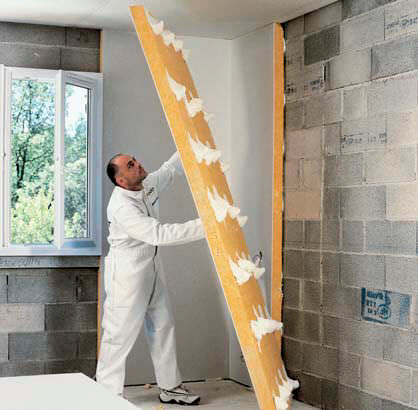
These boards have a mineral fibre panel bonded to the back of a gypsum plasterboard panel. Note at this stage the Bonded Insulation connection or frame type should not be used for insulated panels using PIR as the insulation medium.