Rain Noise#
An international standard for the measurement of rain noise in laboratories was released in 2006, ISO 140-18 "Acoustics — Measurement of sound insulation in buildings and of building elements — Part 18: Laboratory measurement of sound generated by rainfall on building elements".
INSUL can predict levels of rain noise measured according to ISO 140-18.
INSUL can also predict levels of rain noise that occur naturally, based on a statistical model of natural rainfall distribution.
The predictions are based on simple point force excitation theory as described by several reference texts, in particular by Cremer (2005) and Heckl (1960). The theory is also generally consistent with the methods used in EN 12354-2:2000 "Building Acoustics — Estimation of acoustic performance in buildings from the performance of elements. Impact sound insulation between rooms".
Caution
Users should be aware of the limitations. Like any prediction tool, INSUL is not a substitute for test data. Comparisons with test data for airborne sound insulation show that it is generally within 3-5 dBA points for most constructions.
However, as ISO 140-18 is relatively new, there is only a limited amount of test data available for comparison. Because of this, it is difficult to estimate a reliable uncertainty tolerance for rain noise predictions.
Drop Theory#
The accuracy of the rain noise predictions depends critically on the input of a suitable impact force, in this case being a raindrop.
Three different drop shapes have been considered for rain noise predictions:
- Cylindrical drop as proposed by Ballagh
- Cylindrical-hemispherical drop as proposed by Petersson
- Paraboloidal drop as proposed by Petersson
The paraboloidal drop, as proposed by Petersson (1995), is used in the INSUL prediction routines. The drop shape and impact force over time, as described in Petersson's paper, are shown below.
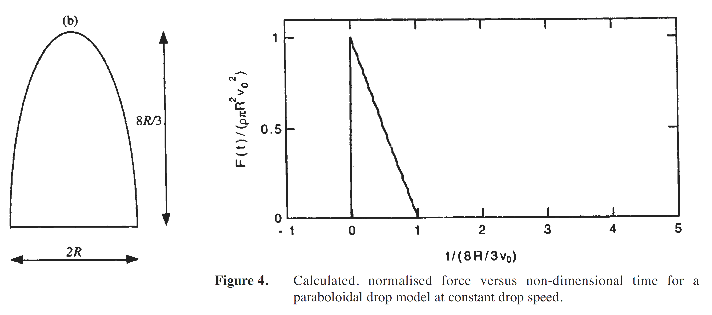
INSUL predictions calculate the impact force of each individual rain drop falling on the roof. These individual impacts are summed per unit time to determine the vibration velocity of the roof, which is then used to calculate the sound radiated from the panel.
Laboratory Rainfall (ISO 140-18)#
ISO 140-18 was released in 2006 to provide a standardized method for the laboratory measurement of rain noise. The ambition of the standard is to provide a means of testing a range of roofing materials, in a way that provides a robust comparison across materials, of the rain noise attenuation characteristics of the materials.
Rainfall used in the test standard uses drops of constant size, with a constant rainfall rate.
Four different rainfall rates are available:
- Moderate: up to 4 mm/hr
- Intense: up to 15 mm/hr
- Heavy: up to 40 mm/hr
- Cloudburst: greater than 100 mm/hr
The drop velocity is also specified in the standard and varies with rainfall rate.
Tip
Standard rain noise measurements use Heavy rainfall.
Rainfall is generated from an elevated water tank with a perforated base. The tank size can be fixed and may not cover the entire roof panel being tested. For example, this can mean that doubling the size of a test panel may not double the measured sound pressure level as the amount of rain fall remains fixed rather than doubling.
Measurements can be made as sound pressure level of sound intensity level. Results should be expressed as sound intensity levels.
Important
With laboratory rain, the tank size can be fixed and may not cover the entire roof panel being tested. For example, this can mean that doubling the size of a test panel may not double the measured sound pressure level as the amount of rain fall remains fixed rather than doubling.
Natural Rainfall#
Natural rainfall predictions are based on a similar approach to that used for ISO 140-18 predictions. However, rather than modeling artificial rainfall from a tank of fixed size, rain fall rates are calculated based on a natural rainfall distribution model as described by Marshall and Palmer (1948).
For a given rainfall rate, the Marshall and Palmer distribution provides the number of raindrops in a particular size range, that are likely to fall in 'typical' natural rain. With natural rain, it is assumed that the drops hit the roof at terminal velocity. Further details of this method can be found in a paper by Ballagh (1990).
Important
An important difference between ISO 140-18 and Natural rain fall prediction is that the area of rainfall according to ISO140-18 is fixed independently of panel size. In contrast, with Natural rainfall, an increase in panel increases the effective area upon which rain fall is incident and, in turn, the predicted level of sound will increase.
Roof#
For information on how to predict levels of rain noise in INSUL, see Roofs in Getting Started.