Single Panels Overview#
Mass Law#
Quote
An old and grizzled Acoustic Consultant once said that the solution to most sound transmission problems was mass....and money..........and masses of money. This illustrates the fundamental importance of mass in sound transmission.
Walls consisting of a single homogeneous panel can be modelled quite well by the mass law up to the critical frequency. The mass law predicts the transmission loss (TL) from the surface mass (mass of 1m2 of the panel) and the frequency.
where:
- m is mass in kg/m2
- f is frequency in Hertz
Tip
The TL increases by 6 dB for each doubling of the surface mass or frequency.
A simple explanation of the mass law is that the motion of the panel is controlled by its inertia, the panel behaving as a limp mass, and the displacement or velocity of the panel reduces as the mass of the panel is increased or as the vibration frequency increases (because it is less easy to make the panel change direction more frequently).
To predict the performance of a material using the mass law one needs only to know the density of the material and the thickness of the material. It provides is a good approximation of TL for the great majority of materials at low and mid frequencies.
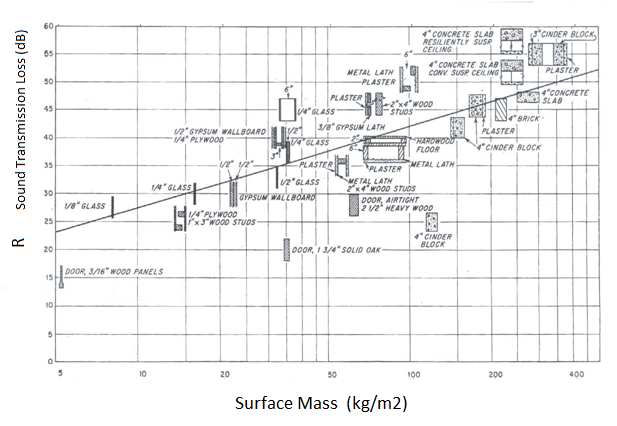
At higher frequencies the interaction of the bending waves in the material with the airborne sound waves reduces the transmission loss to below the mass law.
Bending Waves#
Critical Frequency
At low frequencies most materials behave as simple limp masses and the Transmission Loss can be predicted by the mass law.
Tip
At the critical frequency the wavelength of bending waves in the panel equals the wavelength of airborne sound.
At higher frequencies the bending stiffness of materials becomes important and at a certain frequency known as the critical frequency, the transmission loss dips well below the mass law.
The critical frequency of a panel is determined from the Modulus of Elasiticity (sometimes known as Young's Modulus) and the thickness of the panel.
Above the critical frequency the TL increases at 12 dB/octave (that is, 12 dB per doubling of frequency) so that as the frequency increases the TL can increase to above the mass law.
The critical frequency is high for thin limp materials such as lead, steel and plastic.
For thick, stiff materials such as brick, plywood and concrete the critical frequency can be low. For these types of materials, shears waves can also have a notable effect on Transmission Loss, though this tends to be in the higher frequency region.
A note about FCM
For homogeneous materials the product of surface mass and critical frequency is a constant. This constant is called fcm in INSUL for want of any recognised term.
By implication of the constant, doubling the surface mass (by doubling the thickness of the panel) of a panel will halve the critical frequency. The FCM can be calculated if the Modulus of Elasticity (also known as Young's Modulus) of the material is known. Alternatively, it can be inferred from a Transmission Loss test by examining the curve of TL versus frequency to determine the critical frequency (knowing the surface mass for that test).
For most building materials this constant falls in the range 10,000 to 100,000 Hz kg/m2, with gypsum plasterboard being about 30,000 Hz kg/m2.
Example
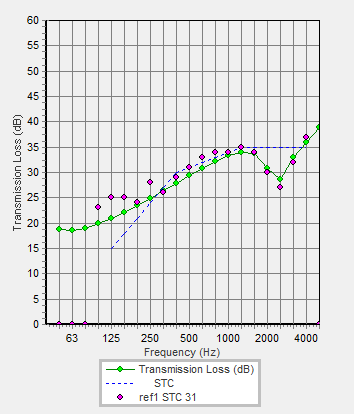
The example below shows the results for 6mm glass, the purple dots are actual test data, the green line the INSUL prediction. Note that 6mm glass has a surface mass of 14.6 kg/m2 and a critical frequency of 2330 Hz, giving a FCM constant of 34,000 kg Hz/m2.
Typical Modulus of Elasticity values in INSUL 10
The algorithms used by INSUL to evaluate the effect of bending waves on the sound insulation performance of a material have been adjusted in INSUL10 (when compared with earlier versions).
Because of this change, Youngs Modulus values used in INSUL models from Version 9 and earlier may require some adjustment when establishing a model for the same system in Version 10 ~ this is particularly the case for gypsum board materials.
When a *.ixl file from INSUL 9 or earlier is opened in Version 10 then, in some cases, an alert message will dislpay to identify the issue.

As an approximate rule of thumb, the Youngs Modulus value from an earlier version of INSUL may need to be increased by ~ 10-20% for a suitable model set up in Version 10.
Although the size of the adjustent can vary from material to material depending on the material thickness, panel size and existing Youngs Modulus value.
Modulus of Elasticity values for concrete in INSUL 10
The default Youngs Modulus value for most concrete materials in INSUL version 9 was 11 GPa.
In INSUL version 10, the default value has been revised to 28 GPa.
The new value, 28 GPa, improves the consistency between INSUL’s material properties and typical property values reported or encountered in practice, which seem to range from about 20 GPa to 40 GPa (or higher in some cases).
The chart below illustrates how the change in Young's Modulus value effects predicted sound insulation performance. The chart presents two prediction curves from INSUL v10.0.7:
- 100 mm thick concrete panel with Young's Modulus 11 GPa shown in pruple
- 100 mm thick concrete panel with Young's Modulus 28 GPa shown in green
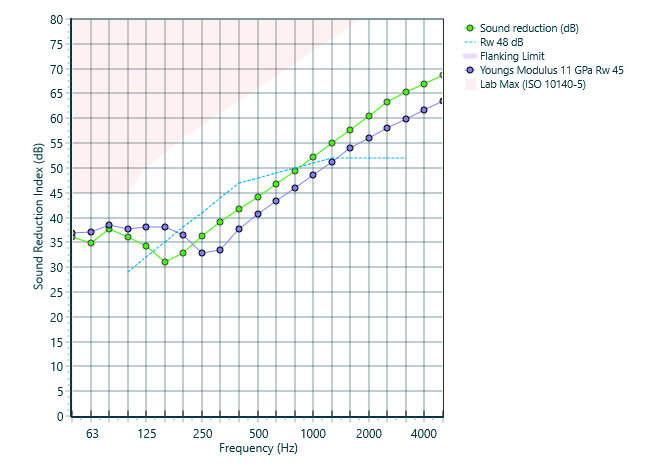
The calculated critical frequency for the 28 GPa system (179 Hz) is lower than the 11 GPa system (258 Hz). Because of this, the sound insulation performance of the 28 GPa system is improved in the frequency region above the critical frequencies.
The chart below provides a comparison between laboratory measured sound insulation performance for a 156 mm thick concrete slab1 (pink dots) and predicted performance using INSUL v10.0.7 (green line). The predicted values have been calculated using a Young's Modulus value of 28 GPa.
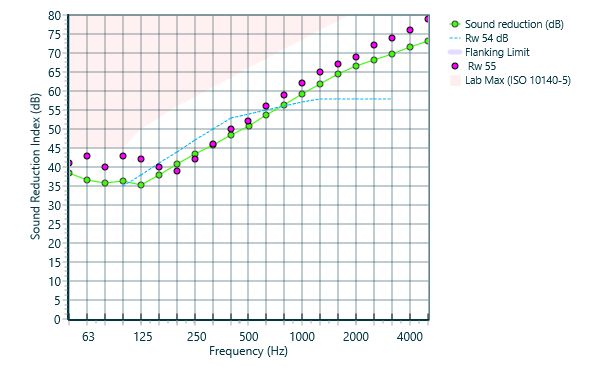
Here's a further example comparing laboratory measured sound insulation performance for a 200 mm thick concrete slab2 (pink dots) with predicted performance using INSUL v10.0.7 (green line). Again in this example, the predicted values have been calculated using a Young's Modulus value of 28 GPa.

Shear Waves#
Shear waves can have a notable effect on Transmission Loss for some thick, stiff materials ~ most typically concrete. The effect generally occurs at higher frequencies, above the critical frequency, and it can reduce the rate of change of Transmission Loss from 12 dB/octave back to 6 dB/octave.
As the thickness of a material increases, there is a drop in the frequency above which shear waves become signfiicant to Transmission Loss.
Damping (Loss Factor)#
Internal damping
The internal damping affects the transmission at and above the critical frequency. Generally it is found that a damping (loss factor) of 0.01 is a reasonable starting point for most building materials, but this can be adjusted to get the best match with laboratory sound insulation test data where this is available.
Edge damping
The edge damping factor models the energy loss that occurs at the edge of a normal partition where sound waves are transmitted into the surrounding structure. This is significant for very heavy partitions in normal constructions.
Adjusting a model's edge damping...
In some laboratory tests and some unusual situations the partition may not be solidly connected to the surrounding structure and so the energy loss is much less. Or, in other words, there is no significant edge damping affecting the sound insulation performance.
By default when INSUL starts, edge damping is enabled.
Edge damping can be turned on and off from the Settings window.

Plate Resonances#
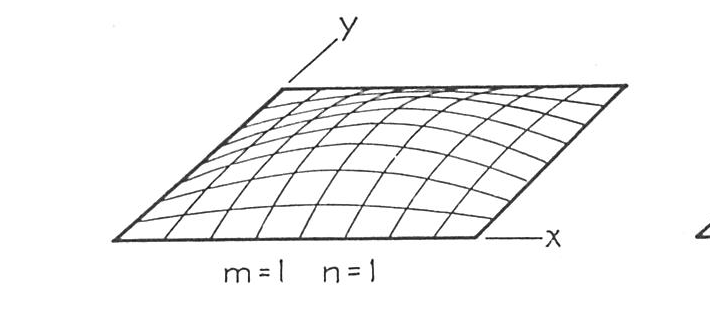
At low frequencies the sound insulation of a partition can be affected by resonances of the stiffened plates formed by the frame supports (typically timber or steel studs) and the linings or layers fixed to them (typically gypsum board or particle board panels). An illustration of what the first mode will look like is shown below (with acknowledgements to Morse).
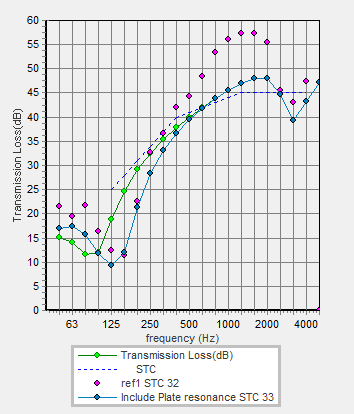
From experimental results it appears that this effect is only significant on sound transmission when panels are rigidly fixed to both sides of the studs. The frequency of the dip at low frequencies that would normally be associated with the mass-air-mass resonance is pushed to higher frequency. A prediction for a steel stud wall with and without allowance for this effect is shown below. The experimental data is shown by the pink dots, the prediction in green does not account for plate resonances, the prediction in blue does. It can be seen that allowing for the plate resonance improves the prediction at low frequencies.
This effect is most important for small stud spacings, say 16" (or 400 mm). It is not so noticeable with stud spacings of 24" (or 600 mm).
Multiple Layers#
Multiple layers of one material
When two or more layers of a material are fixed together they generally do not behave the same as a single layer of increased thickness. For instance, two layers of 12.5 mm plasterboard do not give the same performance as one layer of 25 mm plasterboard.
At low frequencies the TL of both is the same as their combined mass, but the critical frequency of the 2 layers of 12.5 mm plasterboard are the same as each individual layer, whereas the 25 mm thick plasterboard has a coincidence frequency half that of the 12.5 mm thick panel.
INSUL takes account of this and more than one layer of a material can be modelled accurately by changing the Quantity value on the Layer tab (for example, Single > Panel 1 > Layer 1 > Quantity).
Multiple layers of different materials
INSUL can model up to 6 layers of different thickness or indeed of different materials by using the Layer tabs Layer 1 through Layer 6 on the INSUL Panel tabs.

By default the Quantity value for tabs Layer 2 through Layer 6 is 0. To add a material to a panel from anyone of these tabs, the Quantity value should be increased.
Example
As an example, INSUL can model a single panel comprising 3 layers of 16 mm plasterboard and 2 layers of 6 mm plywood and 1 layer of fibre cement.
The INSUL model assumes that the multiple layers are only lightly fixed together. Most normal fixing methods would fulfill this assumption, for instance screws, spot gluing, nailing etc. However, if the layers are intimately bonded together for instance by a full coverage of glue (particularly a rigidly setting glue) then it would be more accurate to model the panel as a single panel of total thickness equal to the combined thickness of the multiple layers. For this reason INSUL models laminated glazing as a single material.