Indoor Space#
The volume of the indoor space and its reverberation time affect the level of sound in the space.
Room volume#
For a given amount of sound energy radiating into an indoor space, a larger room volume will mean a lower level of (reverberant) sound in the room.

Reverberation time#
For a given amount of sound energy radiating into an indoor space, a shorter reverberation time (RT, T60) will mean a lower level of (reverberant) sound in the room.
The reverberation time can often be estimated with reasonable accuracy from a knowledge of the room and its furnishings. It is a convenient phenomenon that for general living spaces such as bedrooms and living rooms the reverberation time of most rooms turns out to be close to 0.5 seconds and reasonably flat across the frequency range. Thus, for normal domestic rooms in the range 20 m3 to 200 m3, you can use 0.5 seconds at all frequencies as a reasonable estimate. For different rooms that are either much larger or more sparsely furnished, the reverberation time should be either calculated or measured.
Reveberation time values can be added directly into the Receiving Room table.
An RT shortcut
If the reveberation time is constant across the frequency range, then a value can be added to the left most RT cell in the table . Selecting '→' will copy that value across the rest of the frequency bands.
Sound levels#
Each time the calculation is refreshed, the estimated room sound level spectrum in the Receiving Room table is updated.
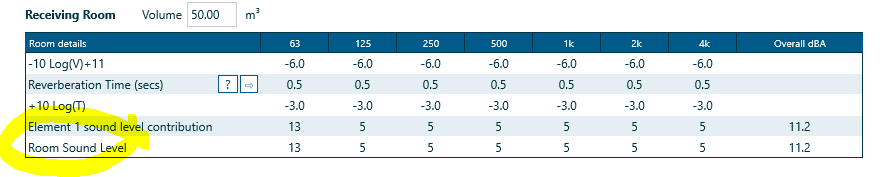
The sound level spectrum contribution of the active element is also shown in the table.
In addition to the spectral data, overall values are displayed for the following items:
- Outdoor sound level
- Element contribution
- Room Sound Level
The default overall value is dBA. NC, PNC and NR criteria are also available. The criterion can be changed from Settings.
Level Difference#
The Outdoor to Indoor Calculator calculates the overall level difference spectrum for the model and displays the result separately from the Receiving Room table.

The Level Difference is calcuated according to the method detailed in EN12354/3.
What is D2m,nT?
This quantity is a standardised measure of facade performance. It is the difference between the outdoor sound level measured 2 metres from the facade (thus including the effects of reflection from the facade), and the spatial average sound level inside the receiving room when the receiving room has a reverberation time of 0.5 seconds (at all frequency bands). This quantity will vary somewhat depending on the volume of the room and the area of facade exposed, so it is not a unique quantity of the partition.
In addition to the spectral data, an overall Level Difference value is calculated. The metric used for the overall value can be changed in Settings.
Overall value |
Comments |
|---|---|
| LpAinc - LpArev,T0 | The difference between the overall A-weighted incident outdoor sound level and the overall A-weighted indoor reverberant sound level1 |
| D2m,nT,w | The overall weighted Standardized Level Difference |
| D2m,nT,w + C | The overall weighted Standardized Level Difference plus spectrum adaptation term2 C |
| D2m,nT,w + Ctr | The overall weighted Standardized Level Difference plus spectrum adaptation term2 Ctr |
-
Normalised to a reference reverberation time T0 of 0.5 s ↩
-
Both the C and Ctr adaptation terms can be calculated for different frequency ranges. For each term:
- The standard frequency range for 1/1 octave bands is 125 Hz to 2000 Hz. Alternative frequency ranges are 63 Hz to 4000 Hz, 125 Hz to 4000 Hz and 63 Hz to 2000 Hz.
- The standard frequency range for 1/3 octave bands is 100 Hz to 3150 Hz. Alternative frequency ranges are 50 Hz to 5000 Hz, 100 Hz to 5000 Hz and 50 Hz to 3150 Hz.