Triple Panels#
INSUL can model triple panel constructions consisting of several layers, with a range of connections between panels, and with and without sound absorptive material in the air cavity.
Example
For instance, it is common to have a masonry wall with plasterboard fixed to battens on each side. Such constructions can have excellent high frequency sound insulation, but with a pronounced dip in transmission loss at lower frequencies.
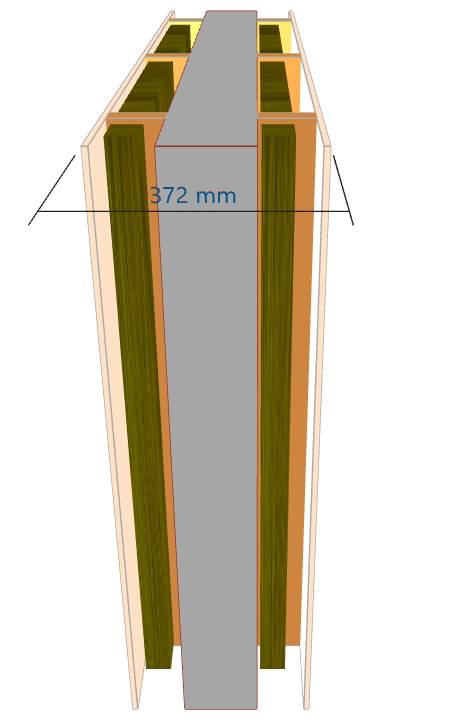
The prediction of the transmission of sound through a triple panel construction is based on the same principles as for the transmission through double partitions. The basic theory for the behaviour of cavities and structural connections which has been used in INSUL for predicting double panel constructions has been found to be quite robust and applicable across a wide range of construction materials. Its extension to triple panels is a natural progression.
Important
It should be noted that the accuracy of triple panel predictions is less than for single and double panel constructions.
To model a triple panel construction:
-
Use the INSUL Panel tabs to select the Triple tab.

-
Update the setup across the Panel 1, Frame 1, Panel 2, Frame 2 and Panel 3 tabs to configure the INSUL model as required.
Warning
-
Prediction accuracy seems to decrease as a function of the number of elements involved in the construction, and so for a Triple panel construction the accuracy is appreciably less than for Single and Double panel constructions. From the available data that we have to compare the results of INSUL predictions against laboratory tests, the accuracy (90% limits) is estimated to be 4 dB for the Rw or STC index.
-
A further warning is also in order, for some triple panel constructions (e.g. masonry walls that have plaster board linings on both sides) the STC rating is controlled entirely by the low frequency dip in the transmission loss curve due to the 8 dB rule. The accuracy of the STC rating is then even less because you do not get the averaging effect across several frequencies normally associated with the Rw or STC rating method. The STC is completely determined by that single frequency with consequently only the lesser accuracy of a single band.