Wave-based Glazing Model#
Info
INSUL provides two separate methods for predicting the sound insulation performance of glazing systems: an energy-based model and a wave-based model.
The wave-based model is discussed below.
The energy-based model of sound transmission through glazing is a hyrid model which minimises the computational cost and hence maximises the calculation speed but does assume that wavelengths are small compared to the window size. As a result, since windows tend to be relatively small (compared to walls), such an energy-based model is often not valid for low frequencies, leading to significant error. In addition, given the empirical nature of the energy-based model it can be more difficult to implement glazing systems where there is little measured data. To address these issues Insul has also implemented a wave-based theoretical model of finite-sized windows using a modal solution approach. Using such a wave-based model, it is possible to implement more glazing system options: additional glazing panes, different glazing frame types, and more infill gas options.
The basis of the wave-based model
The vibrations of the panes of glass and the sound pressure in cavities are expressed as a series expansion of modes. Each mode shape is determined by the boundary conditions and has a corresponding coefficient. The problem becomes one of finding the coefficients that satisfy the Kirchhoff equations of the glass panes, the Helmholtz equation of the cavities, and the coupling between the panes and cavities. To find these coefficients, we use a variational formulation based on Hamilton’s principal, where we minimize the Lagrangian of the system. Such a formulation lends itself to easier addition of components to the system.
Monolithic Glazing#
Options for modelling single, monolithic materials include monolithic glass and a range of clear plastic materials such as Perspex, Lucite, and Lexan.
Vibration damping plays an important role in the performance of monolithic glazing around the critical frequency. A major source of damping, particularly for monolithic glazing, is the seals at the edge of the glass panes. The wave-based model incorporates this effect, using an average value of seal damping determined from previously published work and measurement.
Laminated Glazing#
Laminated glass comprises two layers of glass pressed together with a polymer interlayer material such as PVB (polyvinyl butyral). The important acoustic properties of the viscoelastic layer are the shear stiffness and associated damping.
When laminated glazing is added to a wave-based glazing model:
-
The thickness of the lamination can either be increased in steps of 0.38 mm (15 thousanths of an inch) using the arrow controls or directly entered if other values of thichness are needed.
-
The glass thickness for the pane on each side of the interlayer can set separately as the Side A and Side B thicknesses.

Double, Triple & Quad Glazing#
Compared with the semi-empirical routines implemented for the energy-based model, the wave-based model is more readily extendable to Double, Triple and Quad glazing systems.
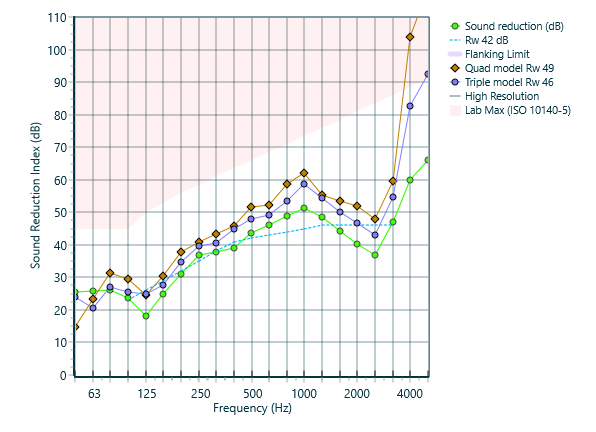
Here is an example which compares predicted sound insulation values for Double, Triple and Quad glazing systems. Each glazing element is 6 mm monolithic glass and each cavity is 25 mm deep, filled with air and with no pane connections (i.e. isolated panes).
Pane Connections#
An important factor that affects the overall sound insulation peformance of double, triple and quad glazing is the edge mounting and connection conditions for each glazing element.
The algorithms implemented in INSUL's wave-based model have been developed to allow a range of different edge mounting conditions, or pane connections, to be considered.
Pane connection |
|---|
| Aluminium frame (Generic type) |
| None (Isolated Panes) |
| IGU (Insulated Glazing Unit, aluminium space pane separator) |
| Wooden sash (Mounted within wood frame) |
| Wood Laboratory Test Frame (Pane sealed directly to frame) |
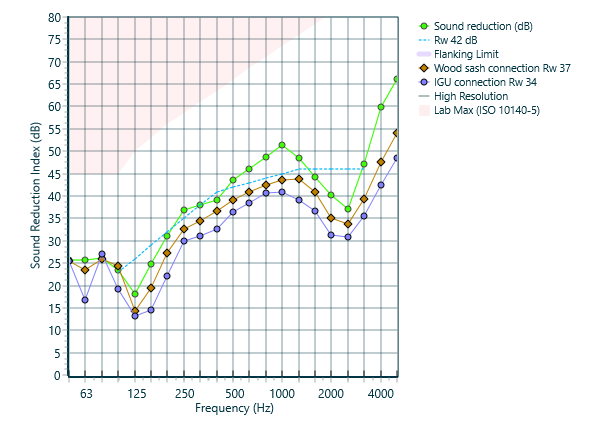
Here is an example which compares predicted sound insulation values for a generic double glazing systems with different pane connections. The generic system comprises:
- 6 mm monolithic glass
- 25 mm cavity with air infill
- 6 mm monolithic glass
What is a pane connection?
In the wave-based model, the pane connection provides a structure borne path for sound to be transmitted from one glazing panel to another. It is analagous to the structure borne path created by a timber stud frame in a light-weight cavity wall.
It is important to note that the pane connection does not consider any direct sound transmission through the edge frame ~ that is, from the source room, directly into the edge frame and lastly radiating from the edge frame into the receive room.
In some cases, this direct path through the edge frame may be an important factor in the overall sound insulation performance of the system, particulary in the higher frequency region. However, because of the often complex profile and shape of the edge frame, it is not trivial to consider this path.
When interpreting results of wave-based model predictions, particularly for high performance systems, a tolerance should be allowed for to account for potential flanking due to direct transmission through the edge frame.
Cavity Gas#
Each cavity between glazing layers can be modelled as being filled with air, argon or krypton gas.
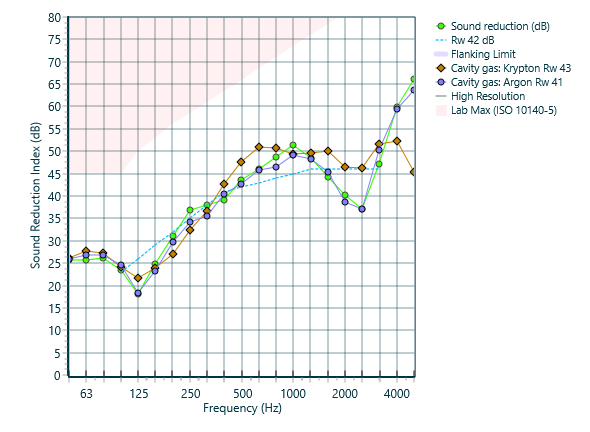
Here is an example showing how changing the type of cavity gas effects predicted sound insulation values for a generic double glazing system comprising:
- 6 mm monolithic glass
- 25 mm cavity with no pane connections
- 6 mm monolithic glass
Free-field Result#
By default, the wave-based model will provide prediction results which assume that the sound field incident on the glazing system is diffuse.
INSUL can also provide a prediction of sound insulation performance for free field conditions, with the sound incident from a specific angle. To activate the free-field calculation, select the Show free field result checkbox on the chart.

Edit the Incident Angle and Angle to Horizontal and calculate the result. Predicted sound insulation values for the free-field case are displayed on the INSUL Chart in blue. In the wave-based model the free-field results will work for any glazing system (in contrast, in Insul 9 this would only work for single glazing).
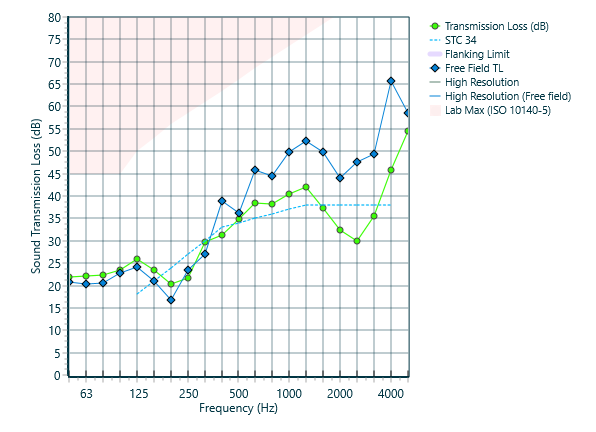
This is an example showing the results of a normally incident plane wave for a double glazing system comprising:
- 6 mm monolithic glass
- 12 mm cavity with an Aluminium Frame connection
- 6 mm monolithic glass
Advanced Settings#
There are several advanced settings which allow the user to change some wave-based model calculation parameters.
Setting |
Details |
|---|---|
| Glazing Diffuse Field Integration Limit Setting | In the wave-based model a diffuse field is determined by averaging the results of plane waves at all incoming angles. Averaging up to the grazing angle of 90° yields a fully diffuse field. Changing this angle to something less than 90° can obtain results for lesser diffuse fields by removing more grazing angle sound energy. A value of 78° is sometimes recommended for laboratory measurements with niches, and lesser values (e.g. 66°) can be tried to simulate field measurements of smaller rooms or deeper niches. The 'Glazing Diffuse Field Integration Limit' setting can be found in the "Settings" window under the Glazing tab. |
| Radiation Damping Effect | The energy lost in a pane of glass due to the radiation of sound is usually not significant compared to other damping effects (such as glazing seals). However, at some resonance frequencies, such as the critical frequency or mass-spring-mass frequencies, there may be a significant effect. The Radiation Damping Effect can be removed by unchecking the "Include radiation damping effect in glazing panes" setting in the "Settings" window under the glazing tab. Doing so is not normally recommended, unless used as a sensitivity check. |