Input Force#
Tapping Machines#
There are several standardised devices used for assessing the impact insulation performance of a floor construction. The most common device is a standardised tapping machine.
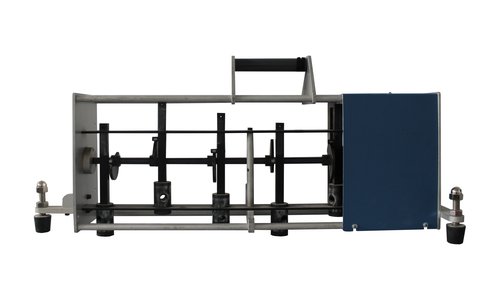
A tapping machine comprises five metal hammers, each weighing 500 grams, which are dropped onto the test floor from a height of 40 mm. Each hammer hits the test floor twice a second meaning that the tapping machine generates 10 impacts onto the floor every second.
The noise generated from the continuous impacting of the tapping machine hammers on the floor is measured in the room underneath the test floor. These Impact Sound Pressure Levels are then normalised and used to determine the impact insulation (IIC and Ln,w) ratings.
Concrete Floors#
INSUL can evaluate impact noise radiation for massive, rigid, homogeneous floor constructions (typically concrete floors). Select the Floor tab to calculate Impact Sound Pressure Levels.
Cremer's (2005) point force excitation theory is used to calculate the energy radiated through the floor slab. The model depends on the following factors:
In particular, the thickness and modulus of elasticity of the floor are used to estimate the floor impedance (the floor impedance can be thought of as the resistance of the floor to excitation by the point source).
Example
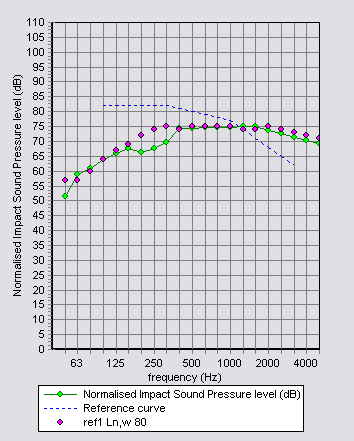
INSUL comparison with measured impact sound pressure levels for a massive, concrete floor construction: 100 mm concrete slab (NRC test IIF-98-003).
The INSUL predicted level is Ln,w 80 dB.
Lightweight Floors#
INSUL can calculate the predicted impact sound insulation for lightweight floors. Select the Floor tab to calculate Impact Sound Pressure Levels.
Theory for point force excitation detailed by Brunskog and Hammer (2003) is used to calculate the energy radiated through lightweight floor layers. The theory is comparable to Cremer's (2005) point force excitation but includes consideration of the resistance and stiffness of the impacted surface, the floor.
The theory provides reasonable agreement with measured data, particularly in the low to mid-frequency regions. The theory is less satisfactory at higher frequencies where there can be a tendency for predictions to be greater than measured data. INSUL includes an additional modelling parameter Impact anisotropy to account for variations in Impact Sound Pressure Level at high frequencies.
Larger than average uncertainty tolerances should be applied to predicted data for thicker lightweight panels.
The model for Impact Sound Pressure Levels on lightweight floors depends on the following factors:
- mass
- thickness
- Modulus of Elasticity (Young's Modulus)
- damping
- impact anisotropy (introduced in INSUL Version 8.0.4)
These properties may be set on the Panel 1 tab. Joist properties also affect the impact sound insulation performance of lightweight floors.
Example
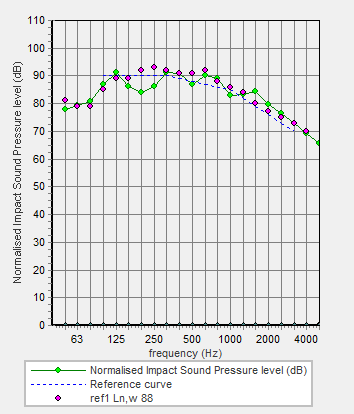
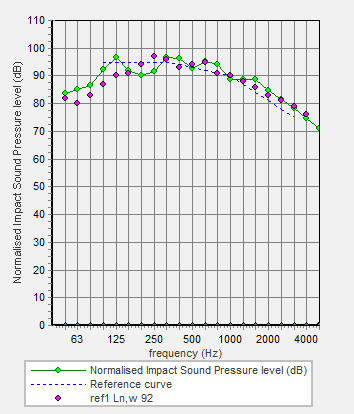
INSUL comparison with measured impact sound pressure levels for a thin, light-weight floor construction: 2 layers of 15 mm plywood (NRC test IIF-96-062).
The INSUL predicted level is Ln,w 88 dB.
Impact Anisotropy#
Impact anisotropy is used to improve general agreement with measured Impact Sound Pressure Level data, particularly in the high-frequency region (1000 Hz and higher). Impact anisotropy is:
- used for some lightweight flooring constructions
- used to account for local variations in material stiffness at the point of impact
- generally relevant for timber floor surfaces only including pine, plywood, OSB and particleboard
Theory
For lightweight floors, point force excitation theory detailed by Brunskog and Hammer (2003) is used to calculate the energy radiated through the floor layers. The theory includes consideration of the local resistance and stiffness of the floor finish at the point of impact by the tapping hammer.
For largely homogeneous materials such as fibre cement sheet, the local resistance and stiffness can be determined from materials properties averaged across the entire floor. For non-homogeneous materials such as timber, using the averaged values can result in predicted impact sound pressure levels that vary significantly from measured values. This is analogous to the use of an orthotropic ratio for calculating the reduction in impact sound pressure levels of some floor covers.
Modelling
Impact anisotropy can be used to account for non-homogenous properties of a floor.
- For homogenous materials including fibre cement sheet and concrete, impact anisotropy can be set to 1.
- For non-homogeneous materials including most timber floors, the impact anisotropy can be set to a value less than 1 but not less than 0. Values between 0.02 and 0.05 are common.
- In the INSUL Materials list, plywood panels have a default impact anisotropy value of about 0.045. Orientated Strand Board (OSB) panels have a default impact anisotropy value of about 0.035.
Because impact anisotropy relates to the material being impacted by the tapping hammer, adjusting the impact anisotropy ratio will only have an effect on the material selected for Panel 1 > Layer 1. That is, just the layer exposed to the hammer. The effect will be most pronounced for lightweight floors.
Attention
In some cases, adjusting the impact anisotropy value by a small amount can have a pronounced effect on the predicted impact sound pressure levels. It is recommended that any adjustments to the values be made in direct comparison with measured impact sound pressure level data.
Example 1
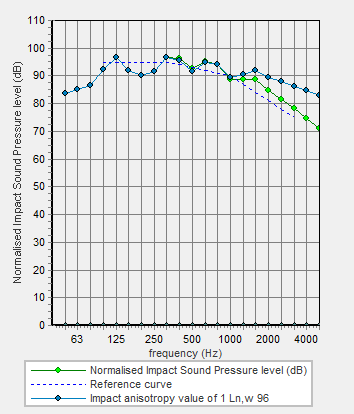
A 15 mm plywood floor on joists at 406 mm centres. On the left hand chart, the blue curve shows predicted impact sound pressure levels with the impact anisotropy value set to 1. The green curve shows the predicted levels with the impact anisotropy value set to 0.045. On the right hand chart the predicted levels of the green curve are compared with measured data (NRC test IIF-96-060).
The INSUL predicted level is Ln,w 93 dB.
Example 2
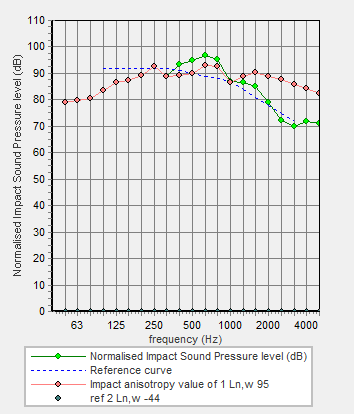
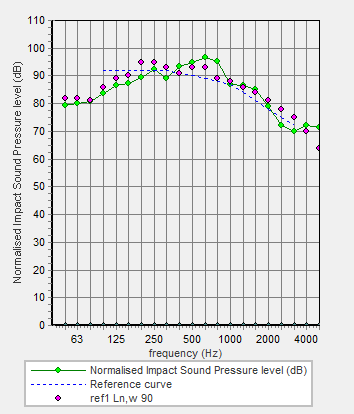
15 mm OSB on timber joists at 406 mm centres. On the left hand chart, the orange curve shows predicted impact sound pressure levels with the impact anisotropy value set to 1. The green curve shows the predicted levels with the impact anisotropy value set to 0.035. On the right hand chart the predicted levels of the green curve are compared with measured data (NRC test IIF-95-038).
The INSUL predicted level is Ln,w 90 dB.
CLT Floors#
In the context of impact sound pressure levels, CLT floors are a sort of intermediate case. They are too thick and heavy to be modelled striclty as a lightweight floor. Concurrently, they are not heavy or rigid enough to be modelled as a concrete floor.
The INSUL algorithms consider CLT floors as a type of hybrid case, with both the Cremer and the Brunskog and Hammer approaches to point force excitation used for different regions of the frequency range.