Sound Transmission Loss ratings#
STC#
STC or Sound Transmission Class is a single number rating for partitions. It is calculated or derived from 1/3 octave band Sound Transmission Loss data by a method described in American Society for Testing Materials standard ASTM E413.
The frequency range for assessment of STC is 125-4000 Hz.
To determine the STC value, a standard-shaped rating curve (the blue curve on the INSUL Graph) is 'slid' up and over the test curve until the sum of the deviations of the test curve below the blue curve add up to just less than 32. In addition, the deviation between the test curve and the blue curve must not be greater than 8 is any 1/3 octave band. By looking at where the green test curve (the partition TLs) is below the blue curve (the STC curve) one can tell what frequencies are determining the STC rating, as illustrated below.

The STC rating was developed to reflect sound insulating performance for speech like sounds and so must be used with caution where low frequency sounds are important (e.g. plant room noise, nightclub noise), as partitions with identical STC's may perform quite differently (see comments below).
Rw#
Rw or the Weight Sound Reduction is a very similar rating to the STC, developed by the International Standards Organisation (ISO). Rw is assessed over the frequency range 100-3150Hz (versus 125-4000 Hz for STC) using the 'sum of deviations less than 32' method descirbed above.
Rw does not include a limitation of no point more than 8 dB below the blue rating curve. In general, the two ratings give either the same number or only 1-2 points difference, so they can be used fairly interchangeably.
Adjustments and alternatives#
As noted above, both the STC and Rw ratings were developed essentially to rate the effectiveness of partitions for insulating against speech like noise sources. However, many modern noise sources contain more low frequency energy than speech and alternative or adjusted ratings have been developed to give a better single number rating for these situations.
ASTM has developed the Outdoor Indoor Transmission Class (OITC) which gives a better indication of the performance of partitions against typical environmental noise sources such as road traffic. The OITC for the partition is given just to the left of the main rating.

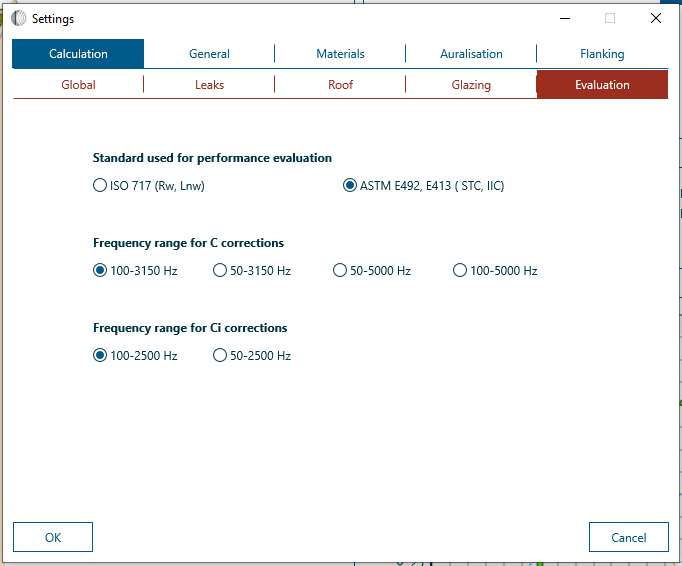
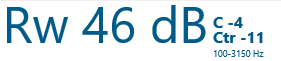
The ISO standards give C and Ctr indices which should be added to the Rw rating to give a rating for noises with either equal energy at all frequencies (C) or road traffic like spectra (Ctr). The frequency range over which the C and Ctr indices are calculated can be set is variable from the Settings window. The index DnT,w is also calculated. This index is dependent on the receiving room volume which can be set in the partition and room properties dialog box. But note this does not include any flanking transmission and so should be regarded as only an indication of the room effect for different sized rooms and as the DnT,w contribution of the direct path only.
Toggle between STC and Rw#
To switch between the STC (ASTM) and Rw (ISO) ratings either:
- Click the STC/Rw panel,
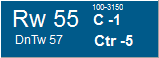 , to toggle between single figure indicies
 - Go into Settings and change the rating and/or the frequency range