Floor Covers#
Measured performance#
The effects of resilient floor coverings are commonly derived from laboratory and field measurements.
Two impact sound pressure level tests are conducted:
- One set on the bare floor construction.
- The other on the same floor construction but with the addition of the floor cover.
The difference in the two sets of measured impact sound pressure levels gives the effective improvement in impact insulation. Relevant test standards are:
- ISO 140-8:1997
- ASTM E2179-03(2009)
In general, measuring the improvement in impact sound pressure levels due to a floor cover is the most reliable way to estimate its performance. The measured improvement can be applied to similar bare construction types (in the case of concrete floor structures, this means the measured improvement can be applied to concrete floors of varying thickness) to model the floor cover's effect on impact insulation for different constructions.
A couple of important items to note:
- Measuring the performance of a floor cover on a lightweight floor and a heavyweight floor will generally give different results. In most cases, measurements on a lightweight floor should not be used to estimate the effect of the floor cover on a heavyweight floor and vice versa.
- Additionally, floor cover performance results from one lightweight floor construction may not be transferable to another lightweight floor construction, depending on the details of the constructions.
Measurement data can be added directly to the Materials Editor in INSUL.
Predicted performance#
It's also possible to predict the improvement in impact sound pressure levels due to floor covers. INSUL includes options for predicting floor cover performance for heavyweight floors, for some types of floor covers. The prediction methods are largely based on theory from Ver (1971). The predictions can include the influence of both a floor cover and an underlay, for the following categories of floor covers:
- Tile
- Screed
- Timber
- Vinyl
- Cork
- Rubber
Predicting the improvement in impact sound pressure levels from floor covers requires consideration of several physical characteristics of the floor cover materials. The relevant characteristics depend on the arrangement of floor covering being modelled, but generally includes:
- The thickness, density, bending stiffness and damping of the floor finish
- The thickness, bending stiffness and damping of the underlay (see also dynamic stiffness).
Additionally, for timber floor finishes, the orthotropic ratio of the floor can significantly affect the predicted performance. This is due to timber having significantly different bending stiffness depending on the orientation of the timber grain relative to the applied force. For many of the timber floor finishes available in the INSUL Flooring lists, the orthotropic ratio is set to about 0.02. For most other categories of floor finish, the orthotropic ratio can be set to 1.
Example
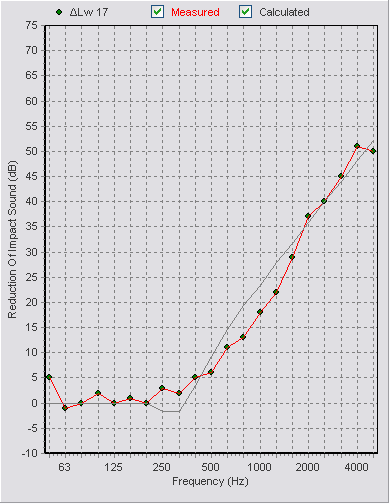
An example of the predicted performance of timber floor finish with an underlay is shown in the figure below. The predicted levels are shown by the grey line.
Dynamic stiffness#
Often manufacturers will provide the dynamic stiffness of their underlay (perhaps measured to according to EN 29052-1:1993).
You can calculate the Young's Modulus easily from the dynamic stiffness: $$ E = s.t $$
where
- E is the Young's modulus
- s is the dynamic stiffness
- t is the thickness of the material
The dynamic stiffness can be entered directly for a calculation. From the Floor tab, select Floor Cover> Predicted and check the Underlay checkbox.
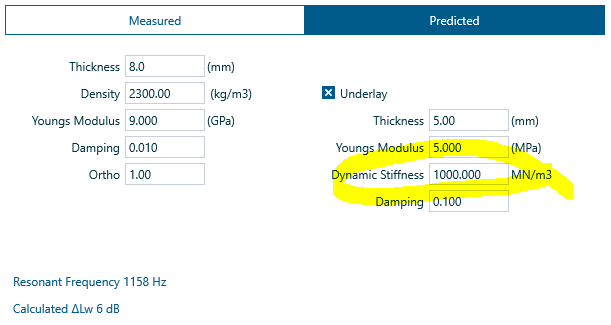
Enter the thickness of the underlay material. Enter a value of dynamic stiffness. When the model udpates, INSUL will calculate the Youngs Modulus value and update the calculation results accordingly.
Types of floor covers#
Resilient Floor Finishes
Resilient floor coverings such as carpet and cork can act as an elastic layer between the noise source and the floor structure and thus reduce the amount of impact energy that is transferred into the floor.
Because floor coverings are relatively thin, improvements in impact noise radiation are generally achieved at high frequencies. Typically, a floor covering will not be able to significantly reduce impact noise at frequencies any less than 500 Hz - 1 kHz.
Resilient batten
A resilient strip or element is sometimes used between the flooring and its supports (either at timber batten, or the top of a timber joist). Some examples of systems are the James Hardie Q Strip, or the Monar Floor acoustic batten system. This frame or connection type can be used to model such constructions, but note that it is only valid when a resilient channel is used to fix the ceiling below.
Floating Floors
INSUL includes an option to predict the impact sound pressure level of certain types of floating floors. Rather than modelling these kinds of systems as floor covers, they can be modelled by choosing the appropriate connection on the Frame 1 tab.
Note
Impact sound pressure level calculations with floating floors are not available for Triple Panel systems.
Mason FSN mounts types of system are typically used in a "jack-up" system in which concrete is cast on to a polythene sheet with the spring mounts cast into the structure. Later, when the concrete is set the whole floor is jacked up on the mounts.

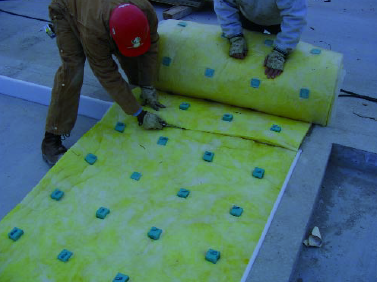
Kinetics RIM types of system are typically "cast in place", where rubber coated fibreglass mounts are used with a plywood shuttering and concrete topping.
Example
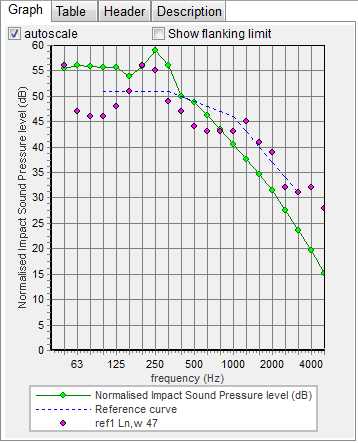
An example comparison between measured and predicted impact sound pressure levels for a floor construction involving Kinetic RIM type mounts is shown in the figure below.
A note about prediction accuracy#
Depending on the inputs into the INSUL model, the agreement between measured and predicted performance can be fairly good. In general, predicted levels are likely to diverge from measurements around the resonant frequency of the floor cover (the approximate frequency of the onset of performance gains due to the floor cover. In the example, this occurs around 315 Hz). This is because the prediction methods expect an ideal or perfect resonance at this frequency. Whilst in practice, a real-world floor cover will include imperfections which affect the magnitude and frequency of the resonance.
Similarly, the INSUL predictions are likely to over-estimate the reduction in impact sound pressure levels at high frequencies. Because the INSUL predictions are theoretical, it is possible to predict a reduction of impact sound of 50 dB and greater. In practice, such significant performance gains as these are not always practicable and/or measurable.
Griffin (2017) provides a discussion of the expected accuracy of predicxtions for floor covers.
A discussion of the accuracy of impact sound pressure levels can be found here.