Sandwich Layers#
Elastic Core Materials#
INSUL can predict the performance of panel materials that have a compressible or elastic core (also inelastic cores). Such materials are often made with thin steel sheets as exterior facings, typically 0.5mm thick, with a core of PIR or expanded polystyrene or rockwool 70 - 250 mm thick. A typical product is the Kingspan KS1000 panel which is widely used for instance in the UK.
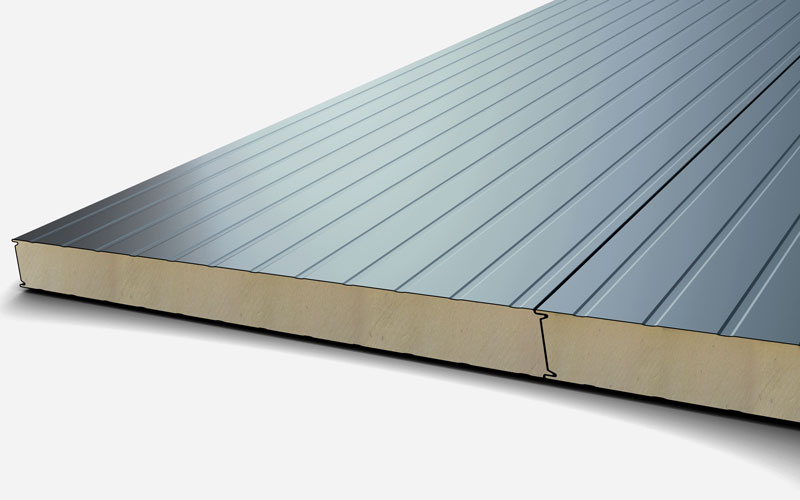
MetecnoPanel (PIR) by Metecno Pir
These types of panel have many useful construction properties such as good thermal insulation, ability to span long distances, and a pre-finished surface which speeds construction times. They are commonly used in industrial and commercial buildings. However they have a very significant dip in their sound insulation performance in the middle of the frequency range (the dilitational resonance frequency, commonly around 1 kHz) which combined with their light weight means that by themselves they have only modest sound reduction properties.
Another example of an elastic cored material is laminated glass which has a layer of a damping material between two layers of glass, for this type of elastic core the dilitational resonance is well above the audible range and so the dip in performance is not significant. For these laminated materials the major effect is the change in critical frequency and increase in damping.
INSUL can accurately predict the performance of elastic core materials (including this dip) and also more importantly can predict the sound insulation performance when combined with other materials, either with additional linings to increase the surface mass, or as part of a cavity wall or roof/ceiling construction.
There are a variety of standard elastic cored materials in INSUL's standard materials file and more can be added either by requesting the developers to add specific materials or by modifying or extending the materials database file using the Materials Editor. The properties that define an elastic core material are the skins (density, thickness, damping and stiffness) and the core (density, thickness, Modulus of elasticity, damping and "plateau"). Note the plateau is a value usually between 0 and 10 dB. It is an empirical constant for a panel that is used to limit the improvement in insulation due to the dilitational resonance at high frequencies. Its value is not very important below about 2 kHz.
Temporary change to an elastic core material can be made from the Properties window. If the material is defined as an elastic core material the following properties will be displayed. Click on the skin on either side or the core to change the relevant properties.

Inelastic Core Materials#
INSUL can predict the sound insulation of panels with a stiff core and external skins.
Example
A typical example is Speedwall/Korok which has a lightweight concrete core inside a thin steel casing.
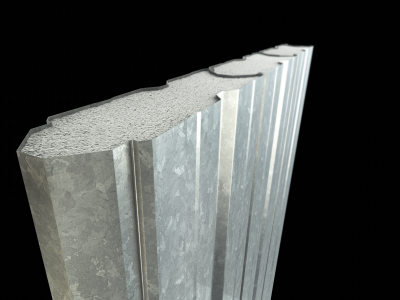
Because their core is very stiff these materials behave quite differently to Elastic core materials.
While INSUL predicts the transmission loss of Inelasitc Core materials using different algorithms than those used for elastic core materials, these two material types have common input properties, with the exception of the Core internal damping and plateau values, which are not used for Inelastic core materials.
Temporary changes to Inelastic Core materials can be made from the Properties window. Permanent changes can be made from the Materials Editor.