Masonry Frames#
In a double panel wall, there are various ways in which the two sides of the wall can be connected. These connections provide a path for the transfer of vibrational energy which is then radiated as sound.
Some of the masonry frames included in INSUL are discussed below.
Masonry walls are typically free-standing, they do not rely on a stud frame or similar to stay upright. Ties, however, are often used to structurally connect separate masonry leaves or walls. Because of this, INSUL's masonry wall frames include a number of different types of wall tie.
Additionally, INSUL includes two idealised frame types (Rigid Point Connection, Line Connection) as well as a tie-free Double Masonry frame type.
Twisted Bar#
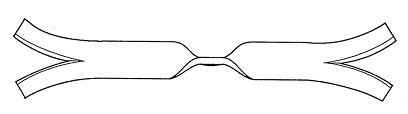
Twisted Bar ties are assumed to be made from comparatively thick steel. They provide a fairly rigid connection between masonry panels and are therefore reasonably efficient at transferring acoustic energy. As a result, INSUL's predicted sound insulation performance for wall systems which use Twisted Bar ties is comparatively low.
Double Triangle#

The Double Triangle tie is assumed to be made from ~3 mm steel rod and it often includes a kink or dip in the middle of the tie to allow condensation to drip. INSUL's sound insulation predictions for Double Trianlge ties are based on the tie being more compliant than a Twisted Bar tie but less so than Butterfly Ties.
UK ADE Type A Wall Tie#
This frame type is specific to the UK, where Approved Document E specifies a Type A wall tie with performance criteria expressed as a dynamic stiffness per square meter. Here is an extract from the 2003 edition, incorporating 2004, 2010, 2013 and 2015 amendments version of Approved Document E.
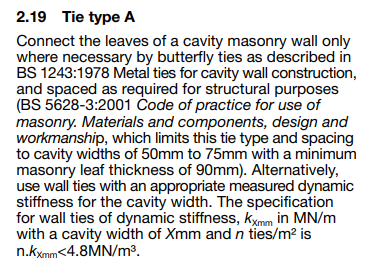
In INSUL, this tie is implemented with a fixed (non-editable), symmetric spacing of ~ 636 mm centre to centre. This is approximtely the same as an asymmetrical tie spacing of 900 mm horizontally and 450 mm vertically (the nominal spacing referenced in Section 2.22 of Approved Document E).
Butterfly Tie#
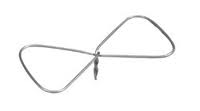
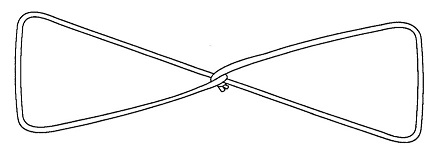
Butterfly ties are steel wires, their name derives from their shape and they are predominantly used in the United Kingdom. They are laid between brick courses across the gap between the two walls.
Published measurements (Hopkins et al, 1999) of dynamic stiffness show that Butterfly Ties can provide better sound insulation performance (per tie) than Twisted Bar ties and Double Triangle Ties.
Rigid Point Connection#
The Rigid Point Connection frame type is an idealised, theoretical connection. As with the Line Connection, it is included in INSUL for reference purposes and has the following properties:
- Zero mass ~ the connection has no mass impedance.
- Zero compliance ~ the connection is not resilient.
Because of these properties, the point connection is very efficient at transferring sound energy between the panels on each side of the connection.
Here is an example comparing predicted sound insulation values for a wall system using the Rigid Point Connection frame type with other frame types available in INSUL. The basic wall system comprises:
- 10 mm plasterboard
- a frame type with nominal, 600 mm centre to centre spacing
- 60 mm glass wool cavity infill
- 10 mm plasterboard
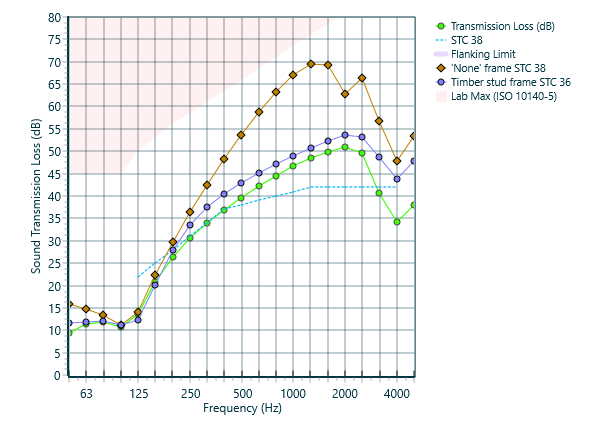
As shown, the highest predicted sound insulation values are achieved by the wall system shown by the brown curve. The model for this wall system uses the None (no connections) frame type. The purple curve shows predicted sound insluation values for a wall with a timber stud frame. The green curve shows predicted values with the Rigid Point Connection frame type (with 600 mm connection spacing).
Connection spacing
The spacing of point connections is an important factor affecting predicted sound insulation values.
The spacing for point connections and wall ties in INSUL is assumed to be in a symmetric grid.
Here is an example comparing predicted values for a wall system using the Rigid Point Connection frame type with varying connection spacing. The wall system comprises:
- 10 mm plasterboard
- Rigid Point Connection frame type with a 60 mm cavity width
- 60 mm glass wool cavity infill
- 10 mm plasterboard
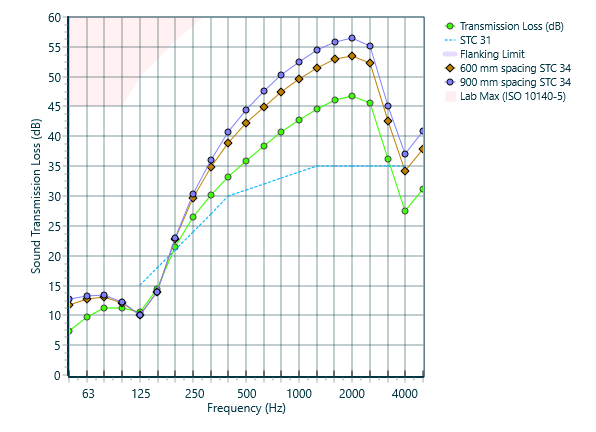
When the spacing between point connections decreases from 900 mm (purple line) to 600 mm (brown line) to 300 mm (green line) the predicted sound insulation values also decrease. This is because each for every extra point connection that is added to the wall there is an increase in the total amount of sound that is transfered between panels.
The INSUL algorithms for the Rigid Point Connection frame have been set up so that each connection to the adjoining panels behaves as a point force. In addition, it is assumed that each point force acts independently of all the other point forces. This can be a useful configuration when assessing a theoretical model.
However, in practice, as the spacing between points connections decreases, the connections will begin to affect the panel in a coordinated way, rather than independently, such that they effectively behave as a line connection and interact differently with the adjoining panels. In essence, the panel sound radiation areas due to each point connection will start to overlap. When this occurs, the Rigid Point Connection frame type will likely under-estimate sound insulation values.
The transition from point connection to line connection behaviour will depend on the bending stiffness of the adjoining panels, the connection spacing and the frequency of sound being considered ~ because of this, there is no simple rule for when the transition will occur. As a very rough guide, where point connection spacing is less than about 400 mm to 500 mm, predicted sound insulation values should be interpreted with additional tolerance.
The Point Connection frame type in INSUL 9
INSUL9 includes a frame type called Point Connection which is similar to the Rigid Point Connection frame type in INSUL10. In both versions of INSUL the frame type represents an idealised, theoretical connection between two panels. However, depending on the physical properties of the panels being joined together by the connection, predicted sound insulation values will vary between versions.
INSUL10 predictions or more sensitive to the bending stiffness of each panel. As the bending stiffness of a panel increases, the effect of the point connection in the INSUL10 model also increases ~ resulting in lower predicted sound insulation values.
Please refer to the discussion of Line Connections for more details about how INSUL9 and INSUL10 prediction results differ for models which use idealised frame types.
Line Connection#
The Line Connection frame type is an idealised, theoretical connection. As with the Rigid Point Connection, it is included in INSUL for reference purposes and has the following properties:
- Zero mass ~ the connection has no mass impedance.
- Zero compliance ~ the connection is not resilient.
Because of these properties, the line connection is very efficient at transferring sound energy between the panels on each side of the connection.
Here is an example comparing predicted sound insulation values for a wall system using the Line Connection frame type with other frame types available in INSUL. The basic wall system comprises:
- 10 mm plasterboard
- a frame type with nominal, 600 mm centre to centre spacing
- 60 mm glass wool cavity infill
- 10 mm plasterboard
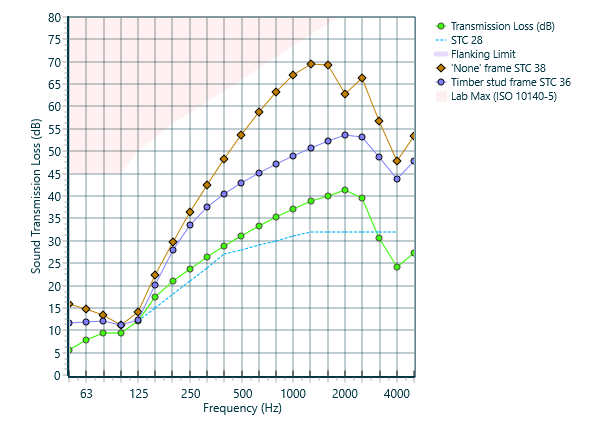
As shown, the highest predicted sound insulation values are achieved by the wall system shown by the brown curve. The model for this wall system uses the None (no connections) frame type. The purple curve shows predicted sound insluation values for a wall with a timber stud frame. The green curve shows predicted values with the Line Connection frame type.
Connection spacing
As discussed for Rigid Point Connections, connection spacing is an important factor affecting predicted sound insulation values for walls using the Line Connection frame type.
The INSUL algorithms for the Line Connection frame have been set up so that each connection to the adjoining panels behaves as a line force. It is also assumed that each line connection acts independently of all the other line connecctions.
In practice, as the spacing between line connections decreases, the connections will begin to affect the panel in a coordinated way, rather than independently, meaning they will interact differently with the adjoining panels. When this occurs, the Line Connection frame type will likely under-estimate sound insulation values.
The transition from independent line connection to coordinated line connection behaviour will depend on the bending stiffness of the adjoining panels, the connection spacing and the frequency of sound being considered ~ because of this, there is no simple rule for when the transition will occur.
The Line Connection frame type in INSUL 9
INSUL9 and INSUL10 both include a frame type called Line Connection. In both versions of INSUL the frame type represents an idealised, theoretical connection between two panels. However, depending on the physical properties of the panels being joined together by the connection, predicted sound insulation values will vary between versions.
INSUL10 predictions are more sensitive to the bending stiffness of each panel. As the bending stiffness of a panel increases, the effect of the Line Connection in the INSUL10 model also increases ~ resulting in lower predicted sound insulation values.
Here are some examples to illustrate this trend.
Example One
Here is an example comparing predicted sound insulation values from INSUL9 (v9.0.24, pink dots) and INSUL10 (v10.0.4, green line) for a wall system comprising:
- 0.6 mm steel
- a Line Connection frame type, with 600 mm stud spacing and 50 mm cavity width
- 50 mm glass wool cavity infill
- 0.6 mm steel
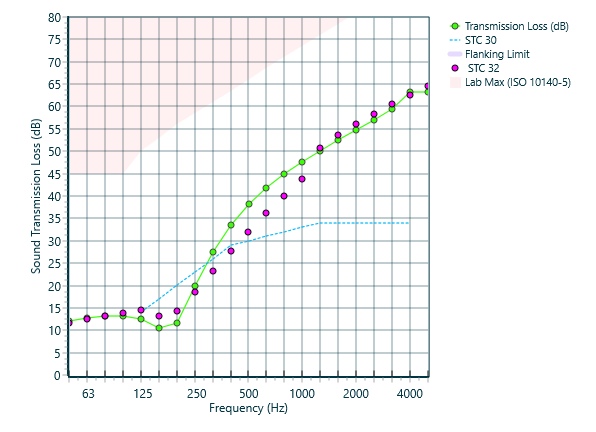
The steel panels one each side of the wall are very thin and comparatively limp. That is they have low bending stiffness. Predicted sound insulation values are similar between the INSUL9 and INSUL10 models.
Example Two
This example compares predicted sound insulation values from INSUL9 (v9.0.24, pink dots) and INSUL10 (v10.0.4, green line) for a wall system comprising:
- 13 mm plasterboard
- a Line Connection frame type, with 1200 mm stud spacing and 90 mm cavity width
- 60 mm glass wool cavity infill
- 13 mm plasterboard
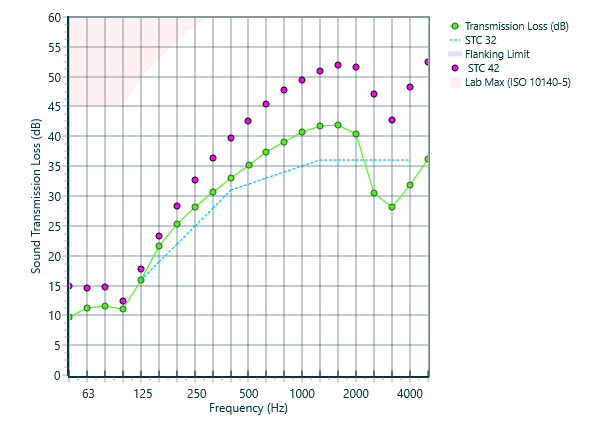
The plasterboard panels one each side of the wall have more bending stiffness than the thin steel panels in Example One. Predicted sound insulation values for the INSUL10 model are lower than the INSUL9 values. The difference in predicted values between the two models increases with increasing frequency.
Example Three
Here is an example comparing predicted sound insulation values from INSUL9 (v9.0.24, pink dots) and INSUL10 (v10.0.4, green line) and measured data (brown dots, data sourced from Vigran (2008)). The wall system comprises:
- 150 mm lightweight concrete
- 50 mm cavity with no framing
- 50 mm glass wool cavity infill
- 100 mm lightweight concrete
Importantly, for this wall system, both lightweight concrete panels were installed into a common collar/frame which acted as a sound bridge between the two panels. This connection has been represented in both the INSUL9 and INSUL10 models as a Line Connection frame type with a nominal connection spacing of 2400 mm.
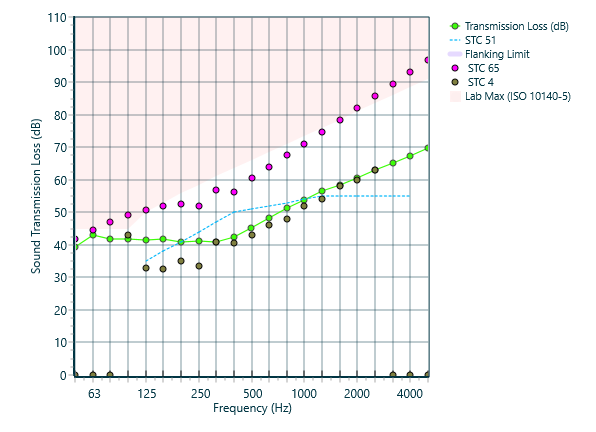
The bending stiffness of the lightweight concrete panels in this example is larger than either the thin steel plates or plasterboard from the previous two examples. The INSUL10 predicted sound insulation values, which are more sesnsitive to changes in the bending stiffness of the panels, are in reasonable agreement with the measured data.
Double Masonry#
This connection type can be used to model the laboratory performance of double masonry walls that have no apparent connections between them.
This option is preferred to either None (no connection) or Double Stud frame types for double masonry walls as based on what limited laboratory data we have the ' "None" option will significantly overestimate the transmission loss.
While every effort is made in laboratory design to eliminate flanking paths, it appears that it is very difficult (at least for masonry walls) to eliminate all traces of flanking. This flanking will generally be paths involving the test walls, so the ultimate flanking of the laboratory may well be greater than the measured performance with masonry walls. Masonry walls are heavy and must be well supported and are well-matched in impedance to the laboratory structure, so there will be some structural transmission between the two masonry walls via the laboratory structure as well as the airborne transmission across the gap between the walls. The structural path has been modelled for a modern laboratory, and may overestimate the transmission loss measured in older laboratories which were constructed with less protection.
Caution
Of course in a field situation flanking will be even more difficult to control than in a laboratory, so the prediction by INSUL must be used with caution and all possible flanking paths are taken into consideration in the calculation of room to room transmission.