Panels#
Single#
To predict the Transmission Loss (TL) of a single panel, from the INSUL Panel tabs select the Single > Panel 1 > Layer 1 tab:

The material being modelled can be changed from the Products list:

Tip
INSUL includes hundreds of different materials, each with a unique set of material properties defined by INSUL. The materials at the top of the Products list in a blue font are the users customisable materials. The materials in the Products list shown in dark grey or black font are INSUL materials.
The Products list can be filtered to sort through materials by Category and Manufacturer. The Products list can also be searched by keyword for quick access to materials.
The thickness of the material can be changed in the Thickness box:

The number of layers of this material can be changed from the Quantity control, by typing a new value or using the < and > controls.

A single panel can comprise more than one material. Materials can be added to a panel as different layers, using the Layer 1 tab through to the Layer 6 tab.
To initiate a calculation, either:
- Click
 on the tool bar
 - Press enter
Material properties#
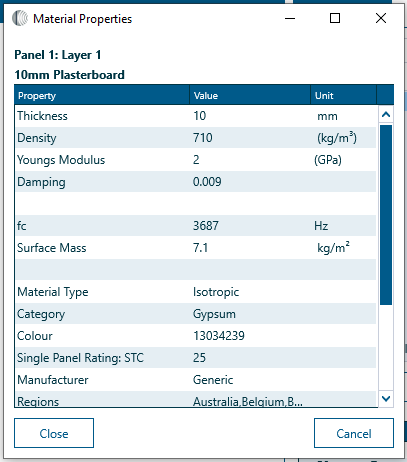
Material properties can be temporarily adjusted from the Material Properties window, which can be opened by clicking on the material in the INSUL Illustration. The Material Properties window provides access to Thickness and Number of, and also the Modulus of Elasticity, damping and other relevant properties.
Info
It is important to note that changes made in the Material Properties window are lost when different material is selected from the Product list.
Materials properties can be changed permanently, and new materials can be created, from the Materials Editor.
Double#
While it is rather simple and accurate to predict the transmission loss (TL) of single panels, it is more difficult to predict walls that have two panels separated by a space. However, since this is such a common type of construction and since it can improve performance considerably various techniques have been developed. Indeed this is the main reason for using INSUL since it makes a complicated task quick and easy.
The easiest situation to understand and explain is two panels separated by an air space with an absorptive blanket in the space between the panels. There is assumed to be no connection between the panels.
-
At low frequencies the stiffness of the air between is so high relative to the inertia of the panels that the two panels are effectively locked together and more or less behave as a single panel. The TL is simply predicted from the mass law using the combined mass of the two panels.
-
As the excitation frequency increases the inertia of the panels increases, at the mass-air-mass resonance frequency the inertia of the panel is cancelled by the stiffness of the air and the two panels move out of phase with each other.
-
As the frequency increases further the TL increases at a much greater rate than the mass law (up to 12 dB/octave). At even higher frequencies the separation of the panel becomes less than ½ a wavelength and the cavity can now be modelled as a room with a single panel wall on each side.
To model a double panel or cavity wall:
-
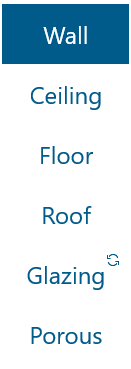
Select the Wall tab from the INSUL Construction tabs
-
From the INSUL Panel tabs, select the Double tab

-
Update panel details from Double > Panel 1 and Double > Panel 2
-
With Double > Frame 1 selected, chose a suitable frame form the Frame Type list

-
Adjust the frame dimensions as required, such as the Cavity Width and Stud Spacing.
-
Enter details of any cavity infill.
The chosen Double system is presented in the INSUL Illustration.
Cavity infill#
When infill such as absorptive blanket is included in the cavity it has several related effects: it dampens the mass-air-mass resonance; it dampens cavity modes which otherwise provide coupling between the two panels, and; it reduces the reverberation in the cavity thus reducing the build-up of sound in the cavity (One might say these are just different ways of looking at the same physical effect).
Frame types#
Some common wall frame arrangements include the following:
- Single stud walls are walls in which the linings on both sides of the frame are rigidly fixed to each other. This is the most common type of wall.
- Steel studs are a common type of wall framing in non-load bearing situations (eg., office walls), which can be modelled by INSUL.
- Double stud walls are modelled reasonably well as double panels without connections.
- Staggered stud walls are modelled reasonably well as walls with line connections at 2.7 metres (the typical wall height and therefore spacing between top and bottom common plates).
- Z Girts are a common frame construction for large industrial buildings.
- Butterfly ties are commonly used to tie brick walls together.
- Suspended ceiling hangers – certain steel and neoprene hangers can provide very high isolation.
- Double Masonry is a connection to be used for walls of two independent heavy masonry walls.
- Resilient batten and steel rail – This is a construction that uses a rubber or neoprene element between the joist and the flooring. It is modelled on the James Hardie QStrip but it could be used to approximate other resilient battens such as the Monarfloor Acoustic Batten System.
Triple & Quad#
There are many common construction forms which include two or even three air-gaps. For instance, it is common to have a masonry wall with plasterboard fixed to battens on each side. Such constructions can have excellent high-frequency sound insulation, but with a pronounced dip in transmission loss at lower frequencies. INSUL can model Triple and Quad panel constructions consisting of several layers, with a range of connections between panels, and with and without sound absorptive material in the air cavity. An example Triple panel construction is shown below.
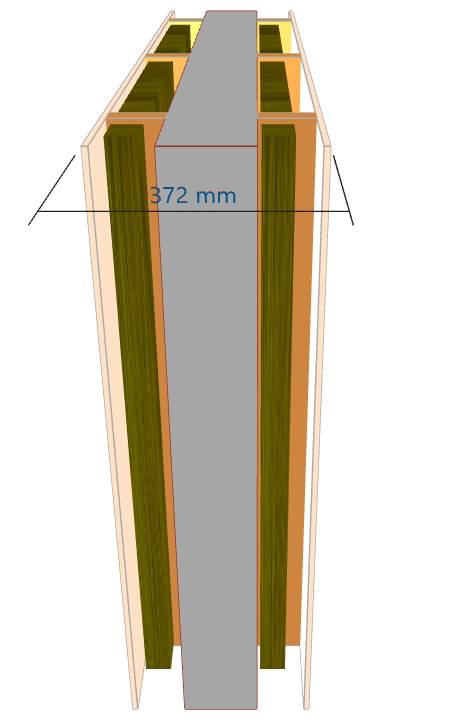
The prediction of the transmission of sound through a Triple or Quad panel construction is based on the same principles as for the transmission through Double partitions. The basic theory for the behaviour of cavities and structural connections which has been used in INSUL for predicting double panel constructions has been found to be quite robust and applicable across a wide range of construction materials. Its extension to triple panels is a natural progression.
Caution
It should be noted that the accuracy of triple panel predictions is less than for single and double panel constructions.
To model a Triple panel construction:
-
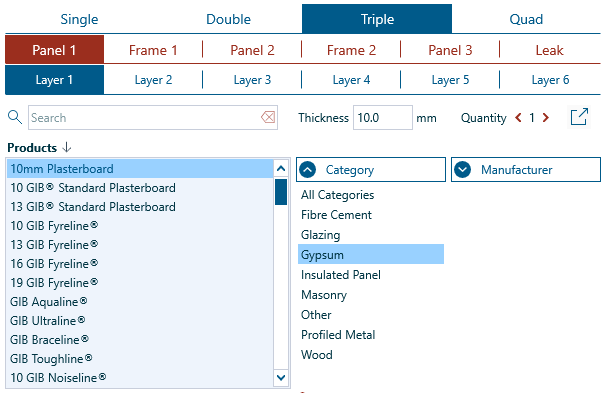
Use the INSUL Panel tabs to select the Triple tab.
-
Update the setup across the Panel 1, Frame 1, Panel 2, Frame 2 and Panel 3 tabs to configure the INSUL model as required.
Warning
Prediction accuracy seems to decrease as a function of the number of elements involved in the construction, and so for a Triple panel construction, the accuracy is appreciably less than for Single and Double panel constructions. From the available data that we have to compare the results of INSUL predictions against laboratory tests, the accuracy (90% limits) is estimated to be 4 dB for the Rw or STC index.
Warning
For some triple panel constructions (e.g. masonry walls that have plasterboard linings on both sides) the STC rating is controlled entirely by the low-frequency dip in the transmission loss curve due to the 8 dB rule. The accuracy of the STC rating is then even less because you do not get the averaging effect across a number of frequencies normally associated with the Rw or STC rating method. The STC is completely determined by that single frequency with consequently only the lesser accuracy of a single band.