Porous Material#
A porous material such as glass wool or mineral wool can be used as a sound-attenuating layer, either by itself or as a facing to a solid barrier.
The porous layer attenuates sound partly by reflecting sound (due to the impedance change between air and the material), and partly by converting sound energy into heat as the sound waves travel through the material.
INSUL can predict the sound reduction performance in two ways:
- As a layer of porous absorber only
- As a porous absorber used as a facing on a partition.
Porous Absorber#
To model the performance of a porous absorber alone:
- Select Porous from the INSUL Construction tabs
-
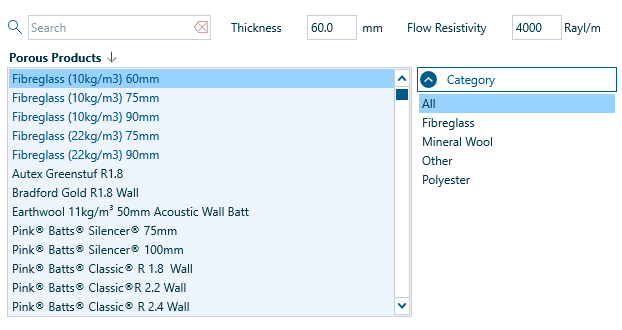
Select a material from the Porous Products list
-
Once a material has been selected, the thickness and flow resistivity can be changed using the edit boxes.
Flow Resistivity Estimator#
INSUL provides a calculator tool for estimating the flow resistivity for several common material types based on their material density.
The calculator tool is provided on the Porous tab. To use the Estimator:
-
Select the Fibre Type

-
Specify the density of the product by entering a value in the Density edit box
- The flow resistivity value will automatically update
Porous Facing#
A porous absorber can be included as a facing to a Single panel prediction for airborne sound, impact sound or rain noise.
To include a porous facing in the model for a Single panel:
- Select Single > Panel 1 and setup the single panel arrangement that is needed
-
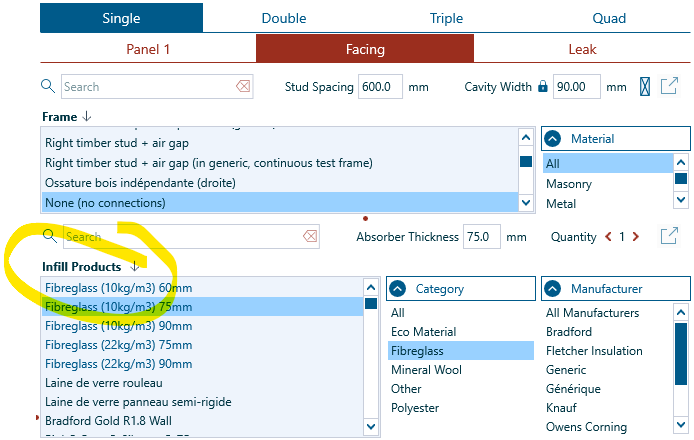
Select Single > Facing and select a porous facing material from the list of available infill products
-
The density, thickness and flow resistivity of the porous facing can be adjusted from the Properties window, by clicking the porous material in the INSUL illustration.